The Somnath Temple stands as a beacon of unwavering faith, divinity and a sacred symbol of India’s eternal soul: PM
The restoration of the Somnath Temple on this exact day 75 years ago was no ordinary occasion; If India attained independence in 1947, then the consecration of Somnath in 1951 proclaimed the independent spirit of India: PM
The Somnath Amrit Mahotsav will serve as India’s guiding inspiration for the next thousand years: PM
Looters tried to destroy the magnificence of the Somnath temple;Thinking of Somnath as nothing but a physical edifice, they kept striking against it; The temple was broken repeatedly, yet it was rebuilt time and again, standing tall after every fall: PM
Not only was the Somnath temple reconstructed, but the country also washed away the blemish of centuries: PM
Somnath serves as a reminder that a nation can sustain its strength over time only if it remains connected to its roots: PM
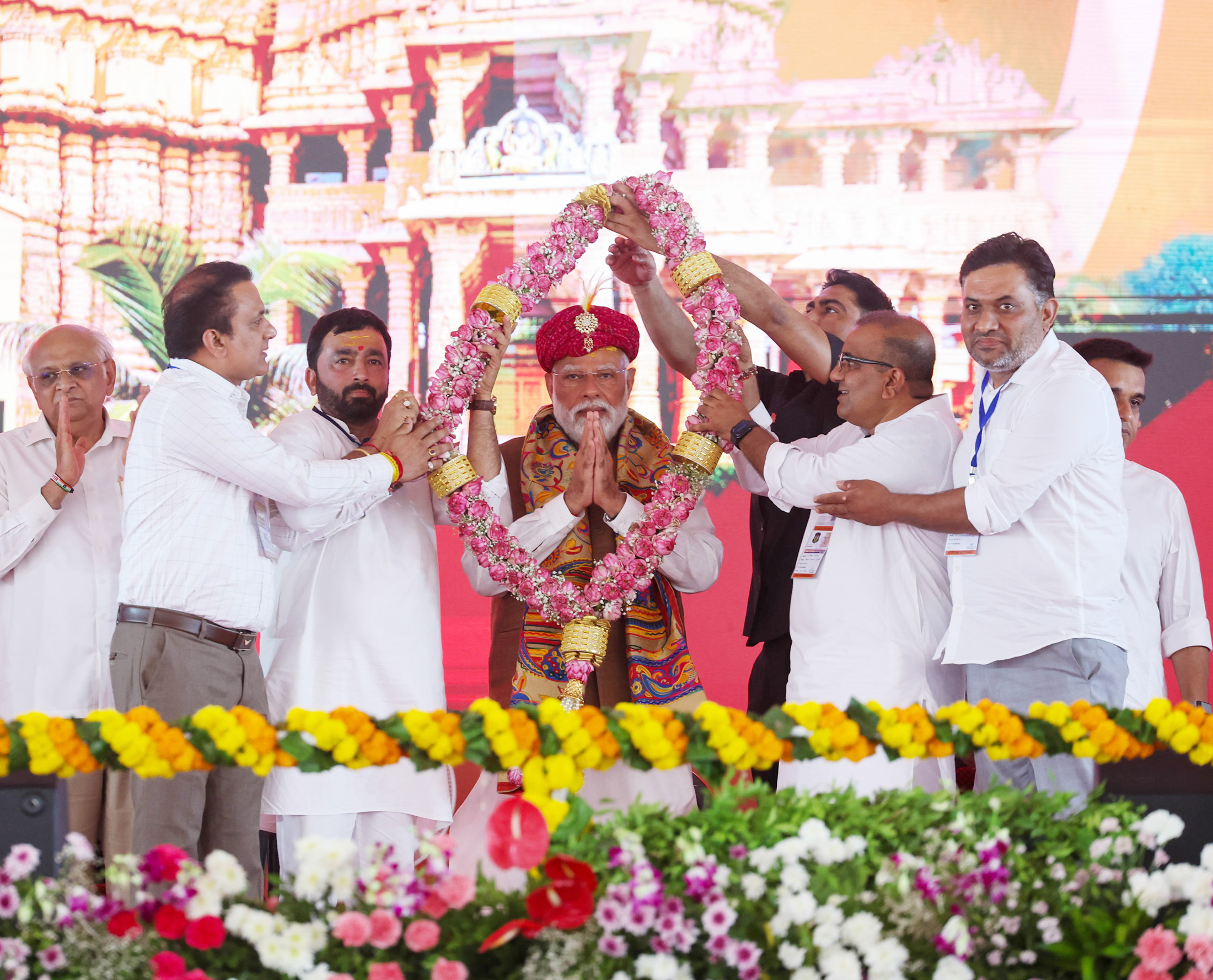
Prime Minister Shri Narendra Modi today participated in Somnath Amrut Mahotsav, marking 75 years since the inauguration of the restored Somnath Temple, Gujarat.
Addressing a grand gathering at the Somnath Temple complex on the occasion of its 75th consecration anniversary, Prime Minister Shri Narendra Modi hailed the event as far more than a ceremonial occasion, but rather a declaration of India’s eternal consciousness and civilizational resilience. The momentous gathering witnessed celestial devotion interwoven with national pride as vedic chants, cultural performances, and the roar of ocean waves converged to celebrate the sacred site’s restoration.
Invoking ancient scriptural wisdom,The Prime Minister described how this creation springs from the divine and merges back into it. “Yato jayate palyate yena vishwam, tamīsham bhaje līyate yatra vishwam, today we are celebrating the festival of reconstruction of His abode,” asserted Shri Modi.Sharing his personal devotion, the Prime Minister recalled his countless visits to the temple as an ardent devotee of Dada Somnath. “I have bowed before Him countless times, but today when I was coming here, this journey through time was giving me a delightful experience,” remarked Shri Modi.
Recalling his recent visit just a few months ago during the Somnath Swabhiman Parv, the Prime Minister highlighted the unique significance of witnessing both commemorations in close succession. “The pride of Somnath being indestructible even 1000 years after the first destruction, and today 75 years of the Pran Pratishtha of this modern form, we have got the opportunity to experience the immortal journey of a thousand years,” affirmed Shri Modi.
Emphasizing the historical importance of the 1951 consecration, the Prime Minister stated that it was no ordinary occasion. “If India became independent in 1947, then in 1951, the Pran Pratishtha of Somnath proclaimed the independent consciousness of India,” asserted Shri Modi.
Reflecting on the profound significance of the Temple’s reconstruction in 1951, just four years after India’s independence, the Prime Minister drew a remarkable parallel between Sardar Vallabhbhai Patel’s political unification of 500 princely states and his determination to rebuild Somnath. “When the nation freed itself from foreign shackles, Somnath’s restoration simultaneously declared to the world that India was not merely independent, it was already reclaiming its ancient glory,” Shri Modi observed.
Articulating the multilayered significance of the occasion, the Prime Minister stated he is not merely witnessing a 75-year retrospective. “I am seeing here the resolve of creation in destruction, which Somnath has fulfilled,” observed Shri Modi. He described perceiving the eternal victory of truth over falsehood in the sacred precincts.
The Prime Minister spoke of witnessing millennia of spiritual consciousness that has imparted lessons of universal welfare. He articulated his vision of India’s indestructible essence embodied in Somnath’s resilience. “I am seeing here that the indestructible form of India which could not be erased by centuries of vicious attempts, could not be defeated,” asserted Shri Modi.
Emphasizing the forward-looking dimension of the celebration, he stated that the Somnath Amrit Mahotsav transcends mere commemoration. “This is not just a celebration of the past, this is also India’s inspiration for the next one thousand years,” affirmed Shri Modi. The Prime Minister extended his congratulations to all countrymen and crores of devotees of Lord Somnath on this momentous occasion.
Connecting the day to another landmark in national history, he reminded the gathering that May 11 also marks the anniversary of India’s Pokhran nuclear tests in 1998. He detailed how the country conducted three nuclear tests on May 11, demonstrating the capability of Indian scientists. He highlighted the subsequent tests on May 13 as proof of India’s unwavering political resolve. “At that time the entire world’s pressure was on India, but under the leadership of Atal ji, the then government demonstrated that for us, nation comes first,no power in the world can make India bow or bring it under pressure,” asserted Shri Modi.
Explaining the significance of the operation’s name, the Prime Minister noted that the Pokhran nuclear test was called Operation Shakti for profound cultural reasons. “Because the worship of Shakti along with Shiva has been our tradition,” remarked Shri Modi. Drawing on Hindu iconography, he explained that Ardhanarishwara Shiva demonstrates the inseparability of Shiva and Shakti. The Prime Minister recalled that when India’s Mission Chandrayaan successfully landed on the moon, the landing site was named in accordance with this same philosophy.Highlighting the etymological connection, he expressed delight at the confluence of ancient wisdom and modern achievement. “How delightful it is that this Jyotirlinga is called Somnath after the name of the moon (Soma),” remarked Shri Modi.
The Prime Minister articulated how the philosophy of worshiping Shiva and Shakti together now inspires India’s scientific advancement. “Today we are seeing this resolve being realized,that our worship of Shiva and Shakti should also become inspiration for the country’s scientific progress,” asserted Shri Modi. He extended congratulations to all countrymen on the anniversary of Operation Shakti.
Tracing the temple’s thousand-year saga of destruction and revival, the Prime Minister illuminated the indomitable spirit that animated this history. Despite successive assaults by invaders like Mahmud of Ghazni and Alauddin Khilji, the temple was reconstructed repeatedly by devoted rulers,Raja Bhoj, Bhimdev I, Kumarapala, Mahipala I, and Rao Khangar, each answering an irresistible spiritual call. “Those who destroyed saw only stone and mortar, but they never understood the intellectual and spiritual power of our civilization,” asserted Shri Modi.
Drawing the nation’s cultural recovery into focus, the Prime Minister acknowledged the contributions of luminaries like sages Lakulisha and Soma Sharma who preserved the region’s sacred heritage. He acknowledged the scholarly contributions of Bhava Brihaspati, Pashupatacharyas and many scholars that sustained the area’s spiritual traditions. PM Modi recognized intellectual Personalities like Vishaldev and Tripurantak who safeguarded the region’s consciousness. Expanding the circle of reverence, he named numerous other great personalities like Veer Hamirji Gohil, Veer Vegdaji Bhil, Punyashloka Ahilyabai Holkar ji, Gaekwads of Baroda, Jam Saheb Maharaja Digvijay Singh ji who dedicated themselves to Somnath’s service. He specifically bowed to the modern architects of Somnath’s restoration like Sardar Patel, Dr. Rajendra Prasad, K M Munshi ji and all such divine souls. He drew inspiration from their legacy for contemporary responsibility. “Their remembrance inspires us that we not only have to carry forward our cultural heritage but also have to pass on this responsibility into the hands of coming generations,” affirmed Shri Modi.
Reflecting on India’s vast cultural inheritance, the Prime Minister noted that cultural sites have been the nation’s identity for thousands of years. Yet he pointed to a painful irony in post-independence India. Drawing international comparisons, he noted that elsewhere in the world, nations whose heritage was destroyed by invaders later came together to restore it. The Prime Minister acknowledged the tremendous efforts made by the founding leaders toward this goal.However, he also referenced the unfortunate opposition they faced from within the leadership. “Yet Sardar Sahab’s unwavering resolve ensured that the nation washed away centuries of shame,” remarked Shri Modi.
Expressing concern about contemporary challenges, the Prime Minister stated that divisive forces remain influential even today. He cited recent examples of opposition to nationally significant cultural projects. The Prime Minister called for vigilance against such divisive thinking. He articulated a vision of balanced progress that honors both dimensions of national development. “We have to move forward taking development and heritage together,” affirmed Shri Modi.
Acknowledging the Temple Trust’s role in economic transformation, the Prime Minister highlighted how Somnath has become a beacon of integrated development, simultaneously a spiritual center and an economic engine benefiting hundreds of families and thousands of livelihoods. “This temple draws people from every corner of the world, and their visits generate prosperity across the entire region,” he observed.
Expanding his vision to India’s sacred pilgrimage network, the Prime Minister catalogued the transformative development undertaken across the country in recent years, the reconstruction of Kedarnath, the beautification of Kashi’s Vishwanath Dham, Ujjain’s Mahakal Mahalok, the Chardham highway project, the ropeway project from Govindghat to Hemkund Sahib the Kartarpur Corridor, and the Buddhist Circuit. “All of this has occurred within 10-12 years, demonstrating that cultural sites are not obstacles to progress, but are indeed centers of India’s spiritual-social system, and have also been sources of the country’s economic progress and gateways to genuine development,” asserted Shri Modi.
Articulating a philosophical foundation for this endeavor, the Prime Minister invoked the Upanishadic declaration “Sarvam Khalvidam Brahma”, all of this is Brahman, explaining that this vision encompasses rivers, forests, mountains, and all of nature as sacred manifestations. “When the world turns toward natural living, we must recognize and share this ancient wisdom. Let us make our sacred places examples of harmonious development for the entire world,” urged Shri Modi.
Emphasizing the role of cultural continuity in national strength, the Prime Minister asserted that when new generations reconnect with their history, faith, and values, the nation’s inner strength deepens immeasurably. “The self-confidence with which India advances today owes immensely to this cultural continuity,” noted Shri Modi.
Concluding with a call to future generations, the Prime Minister reminded the assembly that seventy-five years ago, Somnath’s consecration began a transformative journey. “Today, that journey stands before us in even more expansive form. We must carry it to greater heights while remaining rooted in our traditions, this is the mandate of our times,” asserted Shri Modi.
Speaking at the Somnath Amrut Mahotsav. The Somnath Temple stands as a beacon of unwavering faith, divinity and a sacred symbol of India’s eternal soul. https://t.co/otO2YOCCUL
— Narendra Modi (@narendramodi) May 11, 2026
75 साल पहले... आज के ही दिन सोमनाथ मंदिर की पुनर्स्थापना... ये कोई साधारण अवसर नहीं था।
— PMO India (@PMOIndia) May 11, 2026
अगर 1947 में भारत आजाद हुआ था... तो, 1951 में सोमनाथ की प्राण प्रतिष्ठा ने... भारत की स्वतंत्र चेतना का उद्घोष किया था: PM @narendramodi pic.twitter.com/CG3x0dTXbz
सोमनाथ अमृत-महोत्सव... ये अगले एक हजार वर्षों के लिए भारत की प्रेरणा है। pic.twitter.com/HypSK96Oai
— PMO India (@PMOIndia) May 11, 2026
लुटेरों ने सोमनाथ मंदिर का वैभव मिटाने का प्रयास किया। वो सोमनाथ को एक भौतिक ढांचा मानकर उससे टकराते रहे! बार-बार इस मंदिर को तोड़ा गया...
— PMO India (@PMOIndia) May 11, 2026
ये बार-बार बनता रहा... हर बार उठ खड़ा होता रहा! pic.twitter.com/LVlASBovVF
सोमनाथ मंदिर का पुनर्निर्माण भी हुआ... और देश ने सदियों के कलंक को भी धो दिया: PM @narendramodi pic.twitter.com/Q1Cm09oXuz
— PMO India (@PMOIndia) May 11, 2026
सोमनाथ हमें याद दिलाता है कि कोई भी राष्ट्र तभी लंबे समय तक मजबूत रह सकता है, जब वो अपनी जड़ों से जुड़ा रहे: PM @narendramodi pic.twitter.com/8bFkJ1c4Fg
— PMO India (@PMOIndia) May 11, 2026