 PMINDIA


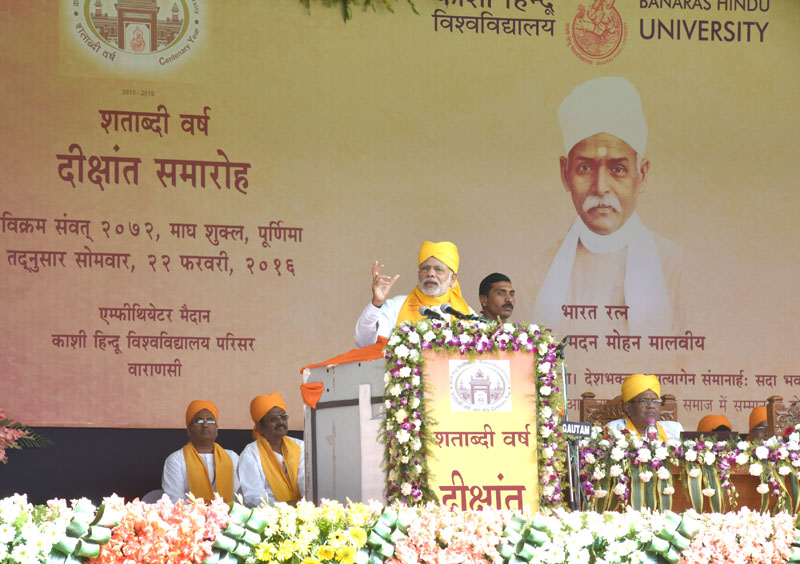
All my student friends, their guardians, members of the faculty and other dignitaries present here!
I had the opportunity to attend Convocation ceremonies earlier also but the honor of attending the Convocation during centenary of a university is something else. I offer my obeisance at the feet of Bharat Ratna Mahamanaji for the seed he had sown 100 years back has now turned into such a huge tree of knowledge, science and inspiration.
Who are visionaries, what are they? In our times if we say this person amongst us is a visionary, it does not make much sense what does a farsighted person mean, what exactly a visionary means ? But if we view this work of Mahamanaji done 100 years ago we can realize what far sightedness is; who is called a visionary. During that period of slavery, keeping the dreams of the nation at heart; he dreamed about what an independent India will be like, and not just dreamed but also identified the primary need to fulfill those dreams. That was to prepare such humans who could realize those dreams and capable, dedicated humans could be made only through education and culture. To fulfill that, Mahamanaji dreamed of this University.
The British who ruled this country were also building universities. But they were building them mostly in the presidencies like Kolkata or Mumbai. They wanted to prepare people in such a way that could help them run their business for a long time. But Mahamanaji wanted to prepare those great people who could retain the great traditions of India and work for the independence of India, for building the nation with their knowledge and capability. Continuing with the Indian traditions was Mahamanaji’s dream.
Mahatma Gandhi repeated this when he built Gujarat Vidyapeeth after about 15-16 years of the work done by Mahamanaji. Both of them wanted to prepare the youth who could do something for the country. But today we see that for the whole century many great people, dedicated scholars gave their knowledge, their efforts and their might to nurture the seed sown by Mahamanaji. In a way they dedicated their whole lives and their generations for this. It is the result of the efforts of many great people that we have the privilege of earning education under this big banyan tree. And therefore, along with the respect for Mahamanaji, I salute all those great people who have contributed towards advancing this great work during the century.
During the century, lakhs of youth have come out from here. These boys-girls in past 100 years have contributed in different areas of life. Some would have become doctors; some would have become engineers; some would have become teachers; some would have become professors; some would have gone to civil services; some would have become industrialists; and there was a period in India when a person, whatever position he had achieved, however prestigious he might be, when he used to introduce himself to somebody, he used to say with pride that he is a student of BHU.
My young friends, during the past century, lakhs of young people have passed out from this university and wherever they went they, however, never let this relationship with the BHU break and not only this, they never hesitated to dedicate their success to the BHU. This is rare because when one achieves some height in life, he feels that he has achieved it, it is due to his own might, discovery or innovation. But it is BHU whose students for 100 years have said in one voice that it was all happening only because of BHU.
What is the strength of an institution? An educational institute can bring a person’s life to the next level. And despite all achievements in life, he feels proud of being alumni of the BHU. I think it is a great thing. But sometimes a question comes that the students of the BHU make it proud, but does 125 crore citizens in every corner of India have the sense of reverence for the BHU in their hearts? What were those work methods, ideologies, trouble being quite hesitant to make it possible to bring this great institution to every person of India? Today, it is the demand of time that not only India but the whole world should see that centuries ago we felt pride for Nalanda, Takshashila, Ballavi, the same pride we have for BHU. This is the heritage of India evolved from the might of centuries. It is the result of austerity of lakhs of people that BHU stands here and therefore this sense of affinity, pride for our tradition and courage to explain the truth to the world is what the world expects from India.
Sometimes I think of yoga. Yoga, it is not a new thing. Tradition of Yoga has been there in India for centuries. The common person has also been attracted personally towards Yoga. In different corners of the world, yoga has been seen with different curiosity. But we lived in that mindset that we never felt that our Yoga has the power that can own the world. Last year when United Nation accepted Yoga as International Yoga Day, 192 countries of the world joined and the world acquired the pride-knowledge. The world enjoyed its joining with Yoga. If we feel proud of what we have, the world becomes ready to walk with us. When this belief is based on the knowledge and has been tested on ideas then it becomes more acceptable. It has been a continuous effort by the BHU.
I heartily congratulate the students and their families, whom we got the opportunity to honor today. I also greet by heart the students who received the degrees today after completion of their education. It is the convocation (‘Deekshant’) ceremony. We should never bring it to our mind that it is ‘Shikshant’ (end of education) ceremony. At times I feel that ‘Deekshant’ (convocation) ceremony in true sense should be ceremony of beginning of education. It is not the ceremony of the end of education and the biggest message of convocation ceremony is that if we have to achieve success in life, if we have to maintain ourselves with the changing trends of life then the first condition is that the student inside us should never fade, should never die.
In this world, only one, who remains student till the end of his life, can achieve this vast creation and the countless dimensions of this huge arrangement.
Today when we are leaving from this convocation ceremony, we have a vast world in front of us. Before now we used to spend time in a world of few square kilometers. We used to meet our acquaintances. We were related to the familiar subject but now suddenly we are coming out of it and stepping into a huge world. These are not common initiatives. On one side there is a happiness that you worked so hard, lived in this campus for three to five years and achieved whatever you could have. But now the world’s point of view towards you changes.
When you were a student, your family, society, friends all were patting on your back to do good, go ahead, study more. But as soon as you come with the certificate, the question arises – what will you do next? When you went for the exam, everybody was pushing you, encouraging you, but when you came back to home with certificate, everybody was asking – “tell me my son what’s the next? Our responsibility is over and now it’s your turn.” And here the test of life begins. And therefore as there are two parts of science – one is science and second is applied science. In the same way the time for applying the knowledge that you acquired in life has come; how you make yourself worthy; how you sustain.
Sometimes inside the campus walls, in the classroom, in the company of teachers, under the guidance of professors, the bigger things seem simple. But when required to do it by myself we find it difficult and repent if we would had paid attention at that time. “At that time I was making fun of my teacher with my friends.” You will remember so many other things. Throughout the life, you will remember those things of university life;” what was it that was left. And if that had not been missed, where I would have been today?” Every moment, these things come to your mind.
My young friends, your chancellor gave a traditional message of discipline. You all know that the tradition of ‘Deeksha’ after ‘Shiksha’ is very old and at first it was mentioned in the ‘Taitrik Upanishad’ where the first occasion of the convocation had been outlined. Since then, the tradition of convocation is going on in India and today also this convocation becomes an opportunity for a new inspiration. You would be able to do much more in life but the student within you should not die; should not fade. Curiosity strengthens the roots of growth. If curiosity stops the life comes to a halt. Whatever is your age, old age will surely come and hence every moment there should be the zeal to do new things to be exactly the same as 20 years ago. Then you will see the real fun to live the life. Life should not ever fade. Sometimes I think I would prefer to die rather than to fade. Life should be blooming. The ability to withstand crises should be there and one who digests it never fails in his life. By momentary things, the life shakes and goes dark. At that time this light of knowledge shows us the path and therefore the knowledge acquired from the land of BHU provides an opportunity to show the lighted path at the time of every crisis in life.
There are many challenges before the country and the world. Can India play any role to these challenges? Why not our institutions, our students dream of giving something to the mankind, to the world? And I wish there should be this feeling in the mind of every student leaving BHU to do something that would be of use for the ages to come.
Innovation- is the strength of social life. New researches are not from just obtaining the PhD degree from the cut-paste world. I was thinking that this might not be known to the BHU people but you know it very well. But I do believe that you would have never used it. Innovation is necessary for us. Even the conditions around us have been hurting me for several days. I met many noble laureates of the world, who have worked in medical science and put a issue before them. I said, “In my country, there is an area where my tribal brothers and sisters live, is cursed by a genetic disease called ‘sickle-cell’. It is devastating my tribal families. It is more fierce and wider than cancer.” There is a pain in my mind that in today’s science everyday some new things are coming for cancer. Can my young people come with some innovation for my tribal brothers-sister suffering from this ‘sickle-cell’? They should devote themselves, discover and give something? And perhaps the one from this country could do better as compared to anybody else in the world because he is conversant with the nature, taste and tendency of this place. I have expectations from the students of BHU to provide solutions for the problems of our country. In solution of those problems can we give something to the coming age?
Today the whole world is upset with Global warming and Climate change. All the countries of world met recently in Paris. In CoP-21, by 2030 the temperature of the world is to be reduced by 2 degrees. The whole world is working hard to meet this target and if it is not achieved we do not know how many islands, how many coastal cities would be submerged. We do not know how destructive the Global warming would be. The whole world is worried. We are a nature loving people. We are the people who consider the whole universe to be a family. We are filled with that knowledge of elements. That’s why the mother teaches the small child –“See my son that sun is your grandfather and this moon is your maternal uncle.” He sees the God in plants, mother in river. This is the culture where exploitation of nature is treated as crime. Can the institutions of India, our scientists come forward with some new innovations to save the world from global warming? Can we show some solid path to world for coming out of these problems? India has taken the responsibility to have more resolutions than that the world has by 2030. Because for centuries we have believed that there should be dialogue with nature, there should not be any conflict with nature.
We have taken two Initiatives. One – the US, France, India and the NGO of Bill Gates are working together on the Innovation. We are working on how to create and maintain renewable energy and solar energy affordable. Second initiative is a collaboration of such countries where the impact of sun heat is for more than 300 days in a year. For the first time, an organization of 122 countries blessed with sunlight has been created with India as its world capital. Recently during the visit of President of France its secretariat has been inaugurated. But the intention is what should we do when the society, the nation, the world is facing crisis?
In UP, the sugarcane farmer remains in trouble but if ethanol is produced through sugarcane and added to petroleum products both the environment and sugarcane farmers would be benefitted. In our BHU we can discover how to use maximum ethanol so that sugarcane farmers are benefitted, welfare of environment and humanity happens and the person driving the vehicle also gets it at cheap rate. These are the things that need innovation.
We are now working on solar energy. India has kept the dream of 175 GW of renewable energy. Out of this 100 GW is solar energy but today’s solar energy equipments have their own limitations. Can we discover such new equipments that can help to get more result, more energy? I have come here to put this challenge before our young friends and from the land of BHU I call upon the youth of India and the world – “Come, let’s sacrifice ourselves for innovation, to find the solution of problems that the human race is going to struggle with in coming century.” Friends, we should dream big. There are so many people who live for themselves but there are few who die for dreams and only those who do not live for themselves but live for their dreams could do big things in this world.
You would have been surprised that in the program today some of my personal guests are present. And you would be surprised to see them too. These are my personal guest, whom I especially urged the university to call them to participate in the convocation ceremony. Government schools are common. Some of the school children are sitting here. They are my special guests. So I called them and now wherever there is convocation in the university, I always request to call some 50-100 poor students of that area. They should see what this convocation is, why they are wearing these costumes, what is given in their hands, what is put in their neck. A small work for nurturing the dreams of the children is being done here. Surprisingly, a small incidence in whole arrangement but in this small incidence there is a big dream lying. My country’s poorest children, who do not get the opportunity to see these things, I always request that these children should come and watch. And I say with belief that the children who are watching it today they would be thinking in their mind – “one day I will go there; I will also wear turban on my head; I will also have 5-7 medals around my neck.” These young people are dreaming such things today.
I trust that those who received the gold medals today should meet school children, talk to them and instill a new confidence in them. That’s the convocation; your work starts from here. Those who are going out of this university today; the young people going to take up their responsibilities in social life; reaching the world, keeping in all that you got from here; all good qualities, which invigorates your inner self, I pray they achieve success at every step of life. My best wishes are with all of you. Thank you very much.
I have got opportunities to attend such ceremonies in the past but to come here, on this special occasion is definitely special: PM
— PMO India (@PMOIndia) February 22, 2016
What Mahamana did here, Mahatma Gandhi made a similar effort through Gujarat Vidyapeeth: PM @narendramodi https://t.co/Iy8hu3Nre5
— PMO India (@PMOIndia) February 22, 2016
People who studied here have contributed through various ways, be it as a doctor, a teacher, a civil servant: PM @narendramodi at BHU
— PMO India (@PMOIndia) February 22, 2016
I congratulate those who were conferred their degrees today. I also convey my good wishes to their parents: PM @narendramodi
— PMO India (@PMOIndia) February 22, 2016
The student is us has to be alive always: PM @narendramodi at BHU https://t.co/Iy8hu3Nre5
— PMO India (@PMOIndia) February 22, 2016
Earlier you were living in this campus, within a few square kilometres but now this changes: PM to students at the BHU convocation
— PMO India (@PMOIndia) February 22, 2016
After you receive your certificate, the way the world will look at you changes: PM @narendramodi
— PMO India (@PMOIndia) February 22, 2016
'Jigyasa' is important. If there is no 'Jigyasa', there is stagnation: PM @narendramodi
— PMO India (@PMOIndia) February 22, 2016
World faces several challenges. We should think about what role India can play in overcoming these challenges: PM @narendramodi at BHU
— PMO India (@PMOIndia) February 22, 2016
Today I have some personal guests here. I have called them specially. They are students from Government schools: PM @narendramodi
— PMO India (@PMOIndia) February 22, 2016
Feeling extremely blessed after visiting Guru Ravidas Temple in Varanasi. pic.twitter.com/SStE1zwTSH
— Narendra Modi (@narendramodi) February 22, 2016
Some pictures from the BHU convocation. My best wishes to those who were awarded degrees. pic.twitter.com/GVIt2cHGWv
— Narendra Modi (@narendramodi) February 22, 2016
Spoke about how India & India's youth can rise to the occasion & take the lead in overcoming the challenges being faced by the world.
— Narendra Modi (@narendramodi) February 22, 2016
Told my young friends- never let the student in you die & its good to be inquisitive & have a thirst for knowledge. https://t.co/9R2abuyzPK
— Narendra Modi (@narendramodi) February 22, 2016


