 PMINDIA


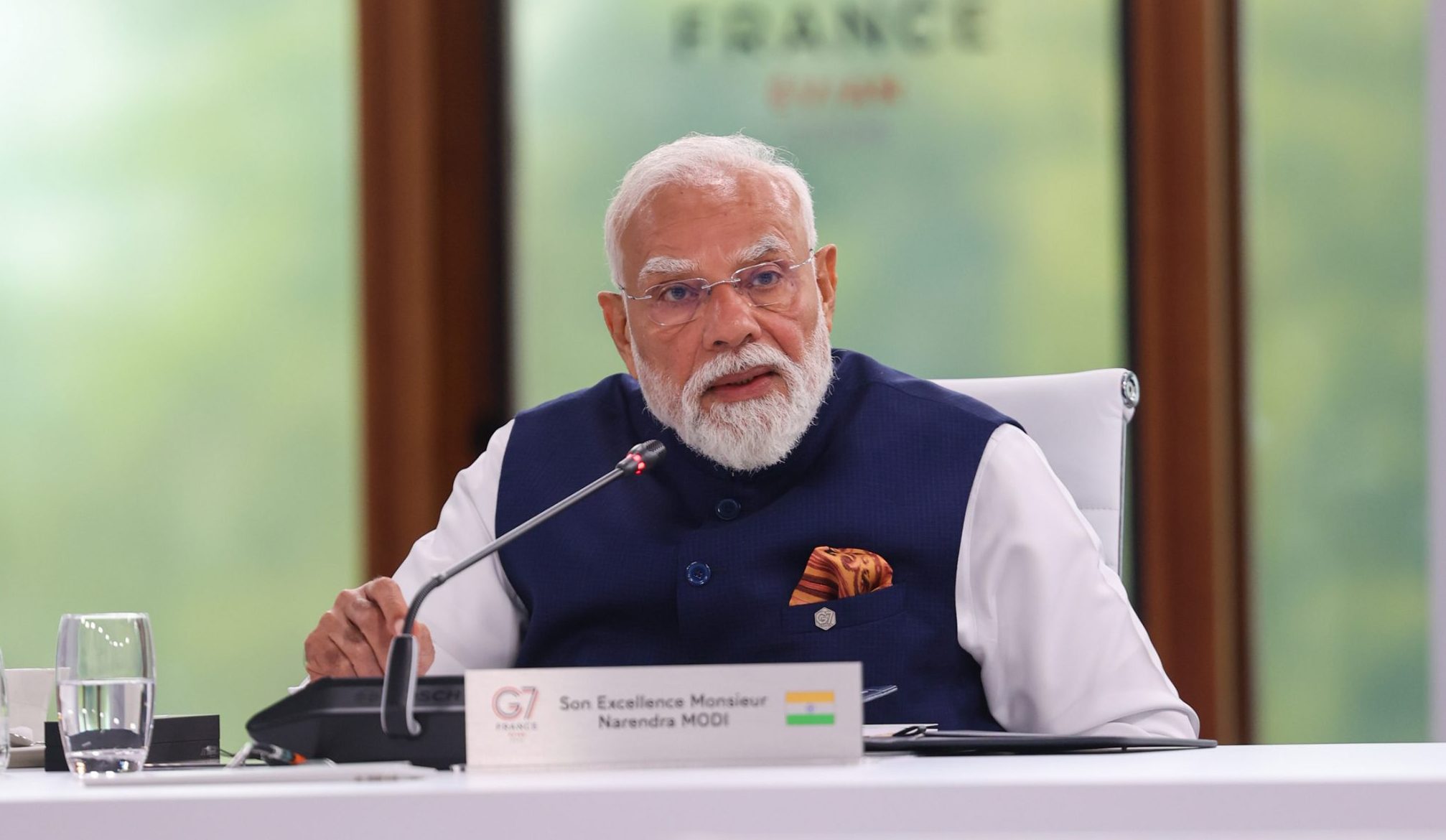
Namaskar!
I sincerely thank President Macron for his warm welcome and hospitality at the G-7 Summit
Friends,
Today’s world is more connected and inter-dependent than ever before. A country’s energy security, food security, health security, cyber security, and economic security no longer depend only on what happens within its borders. Mobility, data, money, and technology, all link us together.
In times like these, strong partnerships become even more important. But partnerships can succeed only when they are built on trust. Today, the most strategic asset is not minerals, technology, or markets – it is mutual trust.
The trust that technology and supply chains will be used for global good, not as weapons. The trust that development opportunities will not be limited to a few countries only. Trust that global institutions will fulfil the aspirations of all countries.
Friends,
In the last century, humanity had to go through two world wars. After many sacrifices, the global community developed systems to move forward towards peace, stability and prosperity. The basis of these arrangements was also trust.
But, the trust built over decades and through the contributions of many generations stands under threat today. COVID-19 exposed that the claims of trust and solidarity were often weaker than people believed.
Today the world does not suffer from a shortage of resources; it suffers from a shortage of trust. And the future of our partnerships depends on building this trust.
Former US President Ronald Reagan once said, “Trust, but verify.” This message remains relevant even today. It is our responsibility towards future generations to build a trusted, rules-based global order that is suited to the needs of the new era.
Friends,
India has always believed that the whole world is one family. Our actions are guided by the principle of “Sarvajana Hitaya, Sarvajana Sukhaya” which means the welfare and happiness of all.
India’s development journey has taught us that progress is most meaningful when it is driven by the aspirations of the people. This principle also shapes our international partnerships. Guided by this vision, India has led several global initiatives, including the International Solar Alliance, Coalition for Disaster Resilient Infrastructure, Global Biofuels Alliance, Mission LiFE, and “Ek Ped Maa Ke Naam.”
India has always considered it our duty to help countries in times of crisis as a First Responder. During the COVID-19 pandemic, India supplied medicines and vaccines to more than 150 countries.
Whether it was a cyclone in Sri Lanka, an earthquake in Afghanistan, floods in Mozambique, or hurricanes in Cuba and Jamaica, India has always responded with a “Humanity First” approach. The same spirit guides our development partnerships, which focus on capacity building and skill development in partner countries.
India believes that the true test of partnership is not what we build for others, but what we enable others to build for themselves.
Friends,
Today, countries of the Global South have high expectations from the international community. However, they are not looking for aid or support alone, they seek genuine partnership. They want to contribute to and participate in global development, not merely receive its benefits.
We must move beyond the traditional donor-recipient approach and build relationships based on equality. Instead of merely working alongside one another, we must work together towards common goals. Our partnerships should be based on dignity and mutual respect, not dependency. By doing so, we can create a strong foundation for the sustainable development for future generations.
Friends,
International partnerships and global solidarity can only be meaningful if we work together to address shared challenges. India firmly believes that lasting solutions to the ongoing tensions and conflicts in various parts of the world are possible only through dialogue, diplomacy, and international cooperation.
We welcome the progress being made towards peace in West Asia. The conflict has caused significant loss of lives and property in our friendly countries in the region. Disruptions to maritime trade through the Strait of Hormuz have also affected the global economy. Many Indian civilians lost their lives. It is our responsibility to ensure the safety of the seafarers who connect nations through global maritime trade. We must ensure that maritime routes remain secure and that seafarers can perform their duties without fear.
Friends,
India stands ready to work with all its partners on these issues.
Thank you very much.
Shared my thoughts at the Outreach Session on ‘Forging New Partnerships and Rebuilding International Solidarity’ at the G7 Summit in Evian. In a world that is getting more interconnected and interdependent than ever before, this subject becomes all the more vital. But,… pic.twitter.com/NjNddWGtFF
— Narendra Modi (@narendramodi) June 16, 2026
Mutual trust is the most important strategic asset today.
— Narendra Modi (@narendramodi) June 16, 2026
But, sadly, today, the world does not suffer from a shortage of resources…it suffers from a shortage of trust.
And the future of our partnerships depends on re-building this trust.
We, in India, view the world as one family.
— Narendra Modi (@narendramodi) June 16, 2026
Our experience shows that development is most effective when it is connected to the aspirations of people.
This principle also forms the basis of our international partnerships like the International Solar Alliance, Coalition for…
India believes that the true test of partnership is not what we build for others, but what we enable others to build for themselves.
— Narendra Modi (@narendramodi) June 16, 2026
Our development partnerships reflect the same spirit.
Our efforts have focused on capacity building and skill development in partner countries.
Emphasised that the Global South has immense expectations from the world. More than support, it seeks partnership.
— Narendra Modi (@narendramodi) June 16, 2026
We must move beyond the donor-recipient mindset and work as equal partners!
We must walk together and not merely alongside one another.
Partnerships must be…
Highlighted India’s efforts in Africa, including the focus on training, capacity building, water resources, agriculture and energy. These are strengthening the capacities of African nations and helping them provide solutions to pressing global challenges.
— Narendra Modi (@narendramodi) June 16, 2026


