For changes to be sweeping and outcomes to be enduring, it is imperative that society and the government work in tandem; That is why, today, initiatives in the education sector are being driven by ground realities,The National Education Policy is a prime example of this: PM
Major startups are emerging from small towns; Women’s participation in startups is also steadily rising;Sectors that were once deemed risky, are now becoming the preferred choice of the youth: PM
If the Covid-19 pandemic was the greatest crisis of this century, then the situation arising from the war in West Asia is one of the major crises of this decade; Just as we collectively tackled the pandemic, we will undoubtedly overcome this crisis too: PM
The government is making relentless efforts to ensure that impact of West Asia war crisis on our citizens is kept to an absolute minimum: PM
As citizens of India, we must give precedence to our duties; In previous decades, whenever the nation navigated through wars or other major crises, every citizen stepped up to fulfill their obligations at the government’s call, Today, there is once again a need for all of us to collectively discharge our duties,and ease the burden on the nation’s resources: PM
Through every effort, big or small, we must reduce our consumption of imported products, and we must also avoid personal activities that lead to the expenditure of foreign exchange: PM
It is the need of the hour that we transform ‘Vocal for Local’ into a mass movement; We must adopt local products instead of foreign goods, and empower the entrepreneurs of our villages, our cities, and our nation: PM
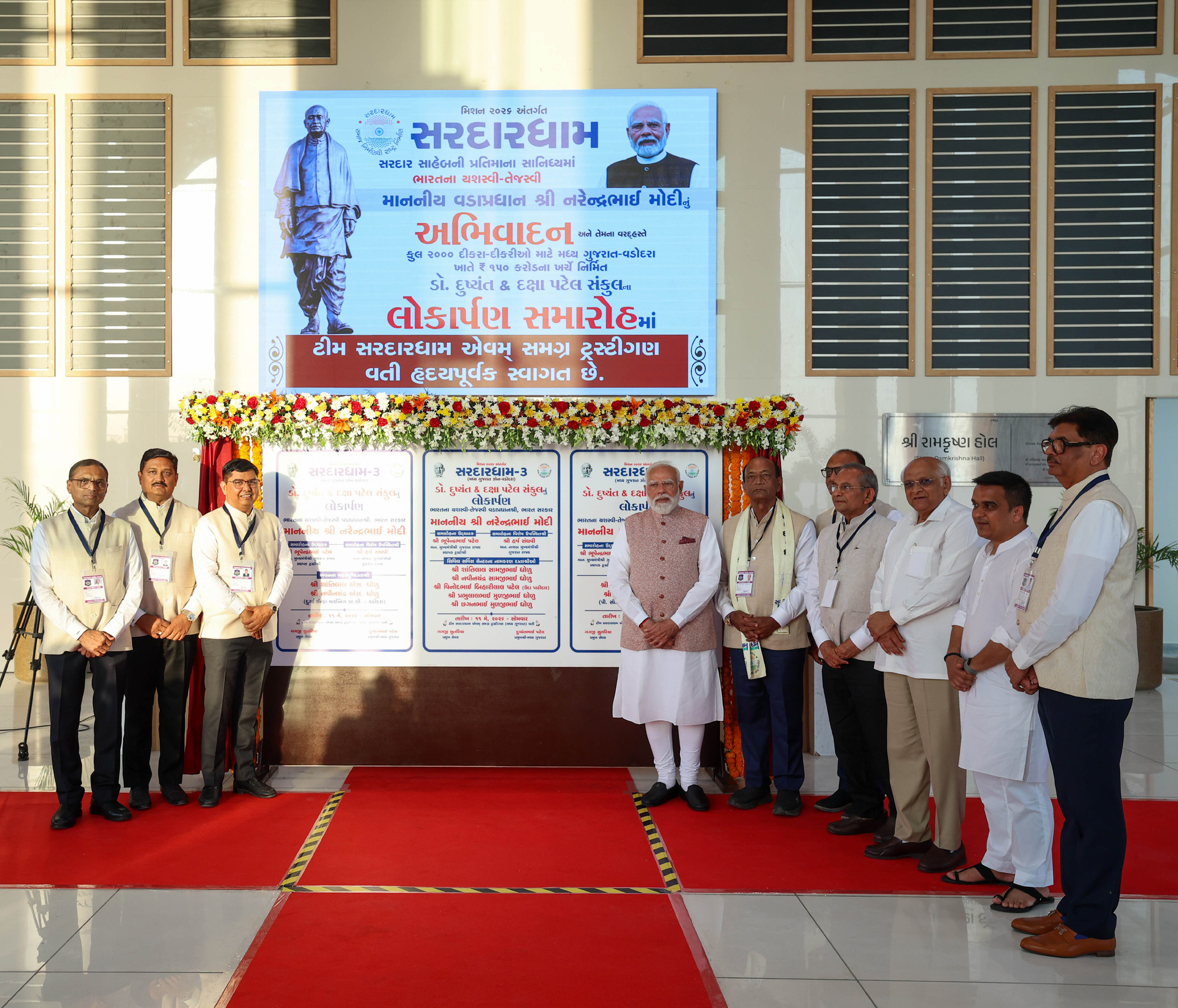
Prime Minister Shri Narendra Modi today inaugurated Sardardham Hostel in Vadodara, Gujarat. Addressing a distinguished gathering at Sardar Dham in Vadodara on the same day Somnath Temple celebrated its 75th consecration anniversary, the Prime Minister marked the auspicious coincidence of educational institution inaugurations with spiritual commemoration. Inaugurating the Dr. Dushyant and Daksha Patel Complex alongside launching the Teaching Assistance Scheme and conducting ground-breaking ceremonies for multiple educational projects, the Prime Minister characterized these initiatives as launching pads for the youth’s future careers. “Just hours ago, I was celebrating Somnath Amrit Mahotsav in Prabhas Patan, and now here we are inaugurating transformative educational institutions, this synchronicity symbolizes how heritage and progress advance together,” observed Shri Modi.
Reflecting on the 75-year lineage of Sardar Dham’s educational mission while cataloguing the organization’s expanding institutional footprint across Indian geography, the Prime Minister recalled his 2021 visit when the girls’ hostel’s ground-breaking ceremony took place, subsequently noting the institution’s presence in Surat, Rajkot, Bhuj, Mehsana, and Delhi. Celebrating the simultaneous launch of a new thousand-capacity girls’ hostel in Ahmedabad’s Nicol neighborhood, he highlighted tangible transformations. “Last year’s inauguration saw thousands of daughters receiving education there, charting new directions for their futures, and today’s ground-breaking for this hostel demonstrates Sardar Dham’s unwavering commitment to expanding educational access for daughters across the nation,” affirmed Shri Modi.
Contextualizing educational transformation within broader frameworks of societal evolution while grounding reform in empirical reality, the Prime Minister asserted that comprehensive change requires collaborative effort between government and civil society. Highlighting the National Education Policy as exemplifying an evidence-based approach to systemic transformation, he detailed the policy’s multifaceted innovations, from eliminating language-based discrimination to embedding skill development and innovation within curricula. “For change to be comprehensive and results to be enduring, society and government must work in concert, and our youth complete their degrees with apprenticeship opportunities that prevent post-graduation disorientation,” noted Shri Modi.
Projecting the demographic dividend emerging from educational investments while celebrating Gujarat’s distinctive entrepreneurial culture, the Prime Minister declared that the state’s youth possess innate business acumen increasingly mobilized through Startup India mission frameworks. Detailing the recent surge in startup formations from smaller cities alongside accelerating women’s participation in entrepreneurial ventures, he observed that previously risk-averse sectors now attract young innovators. “In the coming times, the country will possess such a large skilled workforce that the nation’s manufacturing sector will experience unprecedented acceleration, with sports to space technology demonstrating this transformation over the last decade,” asserted Shri Modi.
Identifying female labor force participation as civilization’s foundational progress metric while crediting Gujarat with recognizing this principle two decades prior, the Prime Minister traced the state’s pioneering gender-inclusive development model. Documenting national replication through the opening of crores of bank accounts crore bank accounts for women alongside sanitation, water, and energy access provision, he highlighted Mudra scheme empowerment and Ayushman Bharat protective frameworks. “Gujarat understood that societal progress fundamentally depends on the participation of its female population and took firm steps accordingly, with these benefits now extending across the entire nation,” noted Shri Modi.
Documenting female workforce integration across historically male-dominated sectors while celebrating daughters’ emergence in leadership roles previously foreclosed to them, the Prime Minister acknowledged accelerating changes in military, aviation, and political spheres. Referencing unsuccessful attempts to pass the Nari Shakti Vandan Amendment through parliament while acknowledging political obstruction, he reiterated unwavering commitment to gender equity objectives. “Female cadets are training at the National Defence Academy, our daughters are becoming fighter pilots, and continuous efforts are advancing women’s political participation, though political reasons prevented the amendment’s passage, our commitment remains unrelenting,” affirmed Shri Modi.
Assigning responsibility for gender-inclusive opportunity expansion across societal sectors beyond government purview while declaring civil society organizations as sharing equal accountability, the Prime Minister positioned Sardar Dham’s particular dedication as exemplary institutional practice. Acknowledging the organization’s comprehensive engagement with women’s empowerment across multiple domains, he extended institutional recognition. “I am pleased that Sardar Dham is undertaking this responsibility with complete dedication and demonstrates through action that societal transformation requires sustained organizational commitment,” stated Shri Modi.
Characterizing Gujarat’s distinctive cultural attribute as rapid recognition of temporal direction while identifying the state’s competitive advantage as organizational capacity to convert disruption into opportunity, the Prime Minister positioned contemporary manufacturing transformation within the historical continuum. Detailing sectoral diversification into advanced domains including semiconductors, aerospace, advanced engineering, green energy, and financial services, he documented the state’s institutional adaptability. “Converting change into opportunity, adopting new possibilities, and preparing for the future in time have been part of Gujarat’s work culture, enabling the state to create new identities across every emerging sector,” affirmed Shri Modi.
Documenting domestic semiconductor production capability while positioning contemporary manufacturing transformation as critical infrastructure development, the Prime Minister noted made-in-India semiconductors being manufactured in Sanand with production already commenced at Kaynes Semiconductor Plant. Detailing new semiconductor projects advancing in both Dholera and Surat alongside articulating national aspiration for supply chain centralization, he identified regional nodes within global networks. “Gujarat is positioning itself as a critical node in global semiconductor supply chains, with Vadodara increasingly playing important roles in this transformation as metro coaches from here already reach international markets,” observed Shri Modi.
Detailing Vadodara’s manufacturing specialization across diverse sectors while highlighting the city’s emergence as a robust hub for engineering, heavy machinery, chemicals, pharmaceuticals, and power equipment, the Prime Minister noted concurrent professional development infrastructure. Acknowledging Gatishakti University’s transport and logistics professional preparation alongside aerospace projects positioning Vadodara for emergence as an aviation manufacturing center, he projected comprehensive economic transformation. “Vadodara has become a manufacturing powerhouse across multiple sectors, with emerging aerospace capabilities suggesting the city’s evolution into a globally recognized aviation hub,” noted Shri Modi.
Acknowledging global instability emanating from multiple concurrent crises while contextualizing contemporary challenges within the historical continuum of uncertainty, the Prime Minister identified pandemic, economic disruption, and West Asian conflict as sequential pressure points. Characterizing West Asian conflict as defining the crisis of the current decade while drawing parallel to pandemic-era collective mobilization, he positioned government action within broader social responsibility frameworks. “From the Corona crisis through global economic disruptions to West Asia tensions, the world faces unprecedented instability that affects every nation, yet just as we collectively overcame Corona, we will certainly overcome this crisis through persistent government effort,” affirmed Shri Modi.
Invoking public participation as an essential resource during systemic stress while appealing for collective commitment to national resilience, the Prime Minister detailed how citizens must prioritize duty and reduce burden on national resources. Quantifying India’s import dependency through crude oil analysis while identifying energy security as acute vulnerability, he noted global supply chain disruptions created by regional conflict. “The country desperately needs power of public participation, as a very large portion of India’s imports constitutes crude oil sourced from regions today embroiled in conflict, creating dual crises of scarcity and price escalation,” asserted Shri Modi.
Prescribing collective action through small individual pledges while detailing petrol-diesel reduction strategies, the Prime Minister advocated for public transport prioritization alongside car-pooling initiatives. Extending conservation appeals to workplace digitalization through virtual meeting prioritization and work-from-home arrangements, he identified technology-enabled solutions as force multipliers. “Wherever possible, reduce consumption of petrol and diesel by using metro, electric buses, and public transport more; both government and private offices must prioritize virtual meetings and work-from-home arrangements to significantly reduce unnecessary fuel consumption,” urged Shri Modi.
Expanding foreign currency conservation imperatives to culinary and precious metal domains while addressing leisure consumption patterns, the Prime Minister appealed for reduced cooking oil consumption with health co-benefits alongside postponement of gold purchases during crisis periods. Observing escalating foreign currency outflows through international vacation trends and destination wedding fashionability, he quantified impact across multiple sectors. “The nation spends significant foreign currency on cooking oil and gold imports while destination weddings consume reserves that could strengthen national resilience, making restraint essential during this period of global uncertainty,” appealed Shri Modi.
Redirecting vacation consumption toward domestic alternatives while leveraging Statue of Unity as a strategic tourism alternative, the Prime Minister advocated for India-centric travel patterns and positioned the monument as a sophisticated wedding venue. Highlighting exceptional facilities and cultural significance alongside economic multiplier effects, he integrated tourism development with currency conservation imperatives. “It is essential we spend vacations within India and choose Indian locations for weddings, with Gujarat alone offering exceptional destinations, and the Statue of Unity offers magnificent facilities perfect for destination weddings while keeping foreign currency within our nation,” urged Shri Modi.
Synthesizing conservation appeals into a comprehensive national movement through the “Vocal for Local” framework while articulating agricultural dimension through indigenous fertilizer and natural farming promotion, the Prime Minister invoked localization across multiple economic sectors. Emphasizing solar pump adoption alongside reduced diesel dependence, he integrated environmental sustainability with foreign currency conservation objectives. “Instead of foreign goods, adopt local products and empower entrepreneurs from your villages, cities, and nation; in agriculture specifically, promote indigenous fertilizers and natural farming while increasing solar pump adoption to reduce both foreign currency outflow and environmental burden,” asserted Shri Modi.
Synthesizing conservation appeals into a collective action framework while invoking the power of mass civic commitment, the Prime Minister identified 140 crore citizens’ coordinated pledge-making as a transformative force. Reiterating the necessity for unified national response while expressing confidence in collective capacity for crisis navigation, he called for comprehensive mobilization across society affirming national resilience. “These efforts may seem small, but when 140 crore people collectively make pledges, small efforts become the nation’s greatest strength. Once again, we must unite so that this crisis does not affect our progress or development, and I am confident that together we will fulfill these pledges and strengthen our beloved nation,” affirmed Shri Modi.
Expressing deep gratitude for the Sardar Gaurav Ratna conferred upon him, the Prime Minister acknowledged the profound responsibility that comes with an award associated with Sardar Patel’s name, noting with characteristic humor that Gagajibhai had cleverly bound him to the cause. Reflecting on what he described as his destiny, he stated that completing Sardar Saheb’s unfinished dreams and continuing the work he initiated has become his life’s mission, assuring the gathering that the blessings received from the people, the values imbibed, and the lessons learned from Gujarat’s soil would sustain his unwavering commitment.
Drawing upon an anecdote about General Cariappa who once remarked that while global honors were gratifying, recognition from one’s own home carried a unique joy, the Prime Minister observed that while India’s growing strength brings international respect, blessings from home multiply one’s capacity to serve.
Concluding with appreciation for Sardar Dham’s educational contributions while extending institutional recognition for transformative work undertaken, the Prime Minister acknowledged the organization’s role in nation-building through educational access expansion. Recognizing today’s project inaugurations as emblematic of societal commitment to youth empowerment, he offered final commendation. “I extend my congratulations for today’s projects, which represent the collective commitment of society to building the nation’s future through education and opportunity,” remarked Shri Modi.
Speaking at the inauguration of Sardardham Hostel in Vadodara. https://t.co/n6YSMRiWyq
— Narendra Modi (@narendramodi) May 11, 2026
बदलाव व्यापक हो, और परिणाम स्थायी हों... इसके लिए समाज और सरकार को मिलकर काम करना आवश्यक होता है।
— PMO India (@PMOIndia) May 11, 2026
इसलिए, आज शिक्षा के क्षेत्र में जमीनी हकीकतों के आधार पर काम हो रहा है।
राष्ट्रीय शिक्षा नीति इसका बहुत बड़ा उदाहरण है: PM @narendramodi
छोटे शहरों से बड़े-बड़े StartUps सामने आ रहे हैं।
— PMO India (@PMOIndia) May 11, 2026
StartUps में महिलाओं की भागीदारी भी लगातार बढ़ रही है।
पहले जिन sectors को risky माना जाता था... वो अब युवाओं की पहली पसंद बन रहे हैं: PM @narendramodi
अगर कोरोना महामारी इस सदी का सबसे बड़ा संकट थी... तो पश्चिम एशिया में युद्ध से बनी परिस्थितियां...इस दशक के बड़े संकटों में से एक है।
— PMO India (@PMOIndia) May 11, 2026
जब हमने मिलकर कोरोना का मुकाबला कर लिया तो इस संकट से भी अवश्य पार पा जाएंगे।
सरकार भी लगातार ये प्रयास कर रही है, कि देश के लोगों पर इसका कम से…
हमें भारत के नागरिक के तौर पर अपने कर्तव्य को प्राथमिकता देनी होगी।
— PMO India (@PMOIndia) May 11, 2026
इससे पहले के दशकों में भी जब-जब देश युद्ध या किसी और अन्य बड़े संकट से गुजरा है, सरकार की अपील पर हर नागरिक ने ऐसे ही अपना दायित्व निभाया है।
आज भी जरूरत है कि हम सब मिलकर अपना दायित्व निभाएं... देश के संसाधनों…
हमें हर छोटे-बड़े प्रयास से ऐसे उत्पादों का उपयोग कम करना है जो विदेश से आते हैं… और ऐसे व्यक्तिगत कामों से भी बचना है जिसमें विदेशी मुद्रा खर्च होती हो: PM @narendramodi
— PMO India (@PMOIndia) May 11, 2026
आज समय की मांग है… कि हम “वोकल फॉर लोकल” को एक जन-आंदोलन बनाएं।
— PMO India (@PMOIndia) May 11, 2026
विदेशी सामान की जगह…लोकल उत्पादों को अपनाएं।
अपने गांव, अपने शहर, अपने देश के उद्यमियों को ताकत दें: PM @narendramodi
वडोदरा में सरदारधाम छात्रावास का उद्घाटन कर अत्यंत संतोष और गर्व की अनुभूति हुई है। pic.twitter.com/bdG5XyHGG7
— Narendra Modi (@narendramodi) May 11, 2026
बड़े बदलाव और बेहतर परिणाम के लिए समाज और सरकार का साथ मिलकर काम करना बहुत जरूरी है। राष्ट्रीय शिक्षा नीति इसका एक बड़ा उदाहरण है। pic.twitter.com/O7J6sbPXaU
— Narendra Modi (@narendramodi) May 11, 2026
हमारे बेटे-बेटियों के लिए सभी क्षेत्रों में संभावनाओं के नए-नए द्वार खुलें, ये सरकार के साथ-साथ समाज की भी जिम्मेदारी है। मुझे खुशी है कि सरदारधाम इस दायित्व को पूरी निष्ठा से निभा रहा है। pic.twitter.com/NXG2R0FTqG
— Narendra Modi (@narendramodi) May 11, 2026
गुजरात के साथ ही पूरा देश ग्लोबल सप्लाई चेन का बड़ा केंद्र बने, इस दिशा में हम लगातार काम कर रहे हैं। आने वाले समय में वडोदरा की भी इसमें महत्वपूर्ण भूमिका होने वाली है। pic.twitter.com/jPgSfsWkHH
— Narendra Modi (@narendramodi) May 11, 2026
140 करोड़ लोग एक कदम आगे बढ़ते हैं, तो देश भी 140 करोड़ कदम आगे बढ़ता है। इसलिए वैश्विक संकट के मौजूदा दौर में देशवासियों से मेरे कुछ विशेष आग्रह… pic.twitter.com/uO5xFHSEUL
— Narendra Modi (@narendramodi) May 11, 2026