 PMINDIA


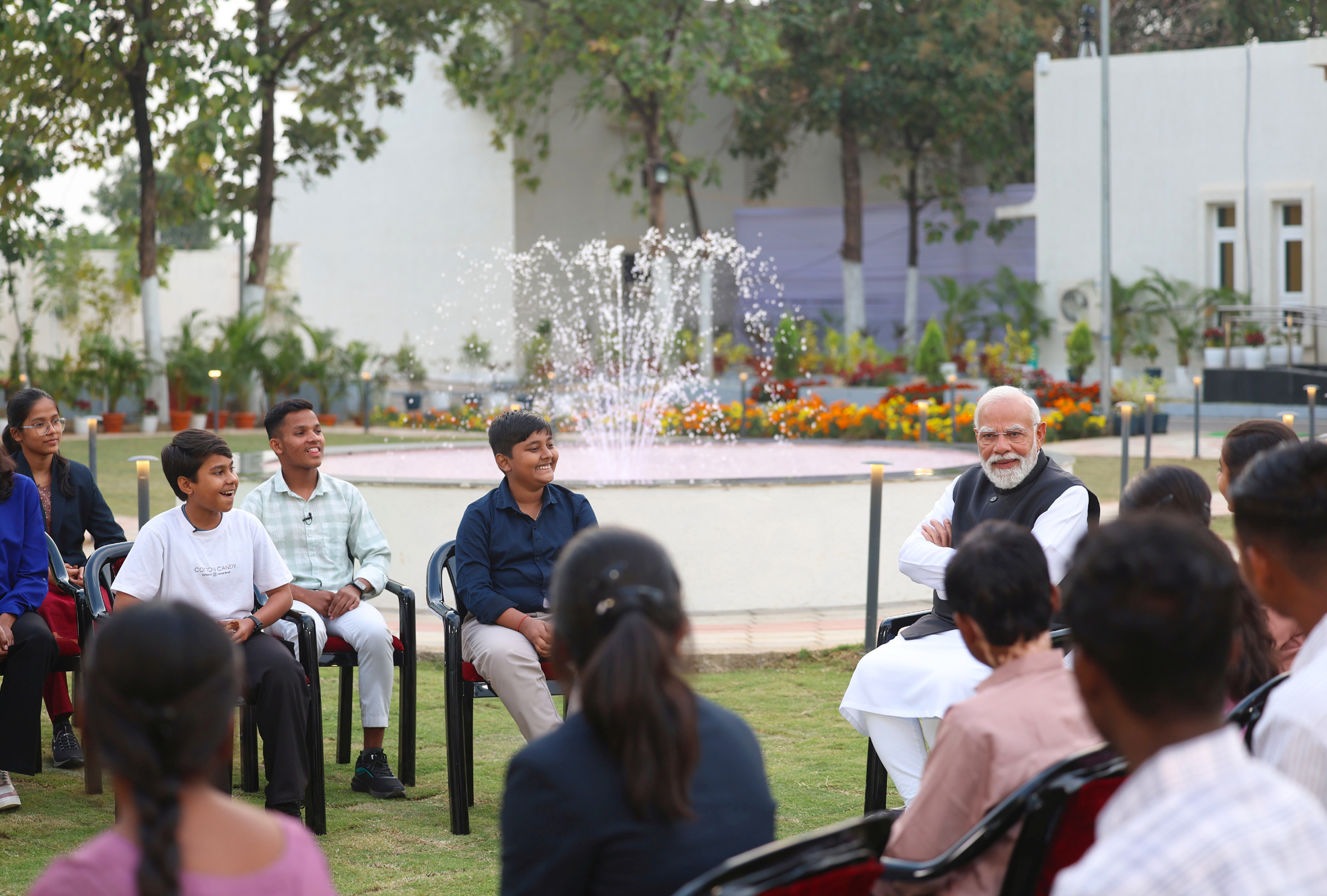
Prime Minister: Vanakkam!
Students: Vanakkam, Sir!
Prime Minister: Did you all get something to eat or not?
Students: No, Sir, we already ate.
Prime Minister: What did you have?
Students: We brought food from home.
Prime Minister: From home, very good.
Student: I couldn’t believe my eyes when I saw him.
Student: First I expected like a dynamic, dramatic entry because he is the Prime Minister after all but he is very simple, humble and down to earth..
Student: When he walked in, I got goosebumps. He was really great.
Prime Minister: For many years now, I have been interacting with students of Class 10 and 12 through Pariksha Pe Charcha. I do this not to teach, but to learn. For me, it is a great learning experience. That is why I am meeting the youth of Tamil Nadu today- to learn from you. So if any of you want to share something, I am here to listen. Who will begin?
Student: My name is Chhavi Jain. I want to start a startup. What subjects should I know about, and at the educational level, what should I do to help me with my startup?
Prime Minister: You are absolutely right. Nowadays, whenever I meet young people, they immediately talk about startups. First, you should focus on what you want to do. Some startups are about technological innovation-someone wants to build drones, someone wants to create new systems for electricity at home. You may know a few friends who are experts in technology, another who is good at finance. Form a small team of four friends and start something on the side. There is no age requirement of 25 years for a startup-you can begin anytime. Even small startups can grow. If you are interested, that is wonderful. Visit some startups, prepare a project report, and tell them honestly, “I am a school student, I am making a school project. They will not hide anything; they will share with you. Gradually, you will gain knowledge about how it can be done.
Student: Sir, I am always afraid that if I focus too much on studies, I will neglect my passion. But if I focus too much on my passion, my studies will suffer. How can I balance both?
Prime Minister: See, first of all, these are not two separate things. Why do you think so? Both are useful. For example, suppose you love art, and you are studying a science subject that talks about a laboratory and mixing chemicals. You can take a sheet of paper, draw the lab, paint it, label the bottles with the names of chemicals. Then, if the lesson says mixing two chemicals produces a certain color, you can draw that in the pot. This way, your art is done, and your lesson is remembered too. So both can be combined beautifully. Your passion for art or craft can also help relieve fatigue from studies. You can dedicate half an hour daily or twice a week to it. Education needed for society must be done, but what is useful for personal life can also be pursued alongside.
Student: Our country is going to join the ranks of developed nations by 2047. My question is: what can we, the youth, do to achieve this?
Prime Minister: I am delighted that even the students of Class 10 and 12 have the dream of a developed India by 2047. This makes me very happy. Now I am excited! What does a developed India in 2047 mean? Have you heard about Singapore? Once, it was just a small fishing village. Today, it has become so advanced. Lee Kuan Yew used to say: “If we want to become a developed country, we must adopt the habits of developed nations.” We cannot behave like a third-world country- throwing garbage anywhere, spitting anywhere. Even small things matter. For example, at a red light, stop your scooter properly. Or at home, decide that after meals, no food will be wasted. Imagine if everyone did this-how much food would be saved, how much benefit would come! As citizens, if we follow such practices, we are contributing to a developed India. Now, take Vocal for Local. I will buy products made in India. I will support Made in India. As I used to say Wed in India. Some wealthy people think of going to Dubai for weddings. Why? What is lacking in India? If we, as citizens, take responsibility for small things, we can surely contribute to building a developed India.
Student: We were shocked. Oh my god, the Prime Minister actually cared about this and told us that it’s the small steps that matter, not the big ones.
Student: My question is: when any student or person lives their life, they face many challenges. When things get difficult, our motivation to keep going often decreases. In such situations, to achieve success, do we need motivation or discipline?
Prime Minister: Both are important in life. If there is no discipline, then no matter how much inspiration you have, it won’t be useful. Imagine a farmer who feels inspired because his neighbor harvests a lot of crops. He thinks, “My land is bigger, I should earn more.” He gets inspiration from this, but when it comes to ploughing the field before the rains, he delays it, saying, “I’ll do it next week.” If he doesn’t plough before the rains, then no matter what he does later, his condition will be poor. He had inspiration, but no discipline. Discipline is essential in life; inspiration adds value to it. Without discipline, even the greatest inspiration becomes a burden and leads to disappointment.
Student: When I asked my question, it was a question that was stucked with me from so many year. Now finally, I feel great and honoured to get a clarity from a person who I have looked up too..
Student: Sir, nowadays AI is becoming more and more influential. We can see that in many companies, there are not just human employees but AI employees too. So my question is: should we be afraid of AI, and what should we keep in mind when choosing our future careers?
Prime Minister: See, in every era, whenever new technology arrives, there is always discussion. When computers came, people wondered what would happen. This has always been the case. We should not be afraid of anything. Our effort should be that we do not become slaves to it. I must remain the decision-maker in my life; technology should not become my master. For example, some children have become slaves to their mobile phones-without a phone, they cannot eat; without TV, they cannot live. That means they have become slaves. We must decide firmly: I will not be a slave. Technology should be used to our advantage. If I ask AI, “Which is the best book on this subject?” and it guides me, that is useful. But if I say, “I won’t read, you just tell me what’s inside,” then that is wrong. The nature of jobs will always change. Earlier, people traveled by bullock carts; now they travel by airplanes. Jobs changed, but life went on. We must understand technology, expand ourselves, and add value to our work with it. If we do this, then no matter how advanced technology becomes, it will always be useful to us. We don’t need to fear it.
Student: I never believed I would be the one to be chosen, to have such a gracious occasion with our Prime Minister.
Student: It was a really great experience. I am completely overwhelmed, and it felt so real.
Student: He felt more like family than a Prime Minister.
Prime Minister: Friends, our young companions in Coimbatore are very aware of AI, startups, and future technologies, along with their studies. I can say this is the youthful thinking of young India, which is giving new strength to the resolve of a developed India by 2047.
Prime Minister: Friends, the meaning of Pariksha Pe Charcha is to sit together, talk, and learn from each other. Continuing this series, after Coimbatore, our discussion reached Raipur, the capital of Chhattisgarh, a few weeks later. There too, I had very interesting conversations with the children. And I must say, it wasn’t just discussions-I also got to taste some delicious local food. You too can enjoy this.
Student: Jai Johar, Sir.
Prime Minister: Jai Johar.
Prime Minister: Did they give you something to eat?
Student: Yes, Sir.
Student: Sir, you attend so many meetings. Would you like to eat something here with us?
Prime Minister: How is it made?
Student: Sir, we shape gram flour into small circles and fry them.
Prime Minister: Oh, and?
Student: It’s savory.
Prime Minister: When do people eat this?
Student: Sir, mostly during Diwali.
Prime Minister: During Diwali, I see.
Student: Yes, mostly at Diwali time.
Prime Minister: Do you know what is this called in Maharashtra?, this is called chakli.
Students: No Sir.
Prime Minister: In Maharashtra, this is called chakli.
Student: Yes, Sir.
Prime Minister: And what is this?
Student: Sir, this is khurmi.
Prime Minister: Ah.
Student: It is made from jaggery, flour, and semolina.
Prime Minister: Thank you, child, for offering such wonderful food.
Student: He was given khurmi, and then he personally fed each of us one piece. It was just so amazing.
Prime Minister: You must also have some questions in mind. Today you have the chance to ask them.
Students: Yes, Sir.
Prime Minister: Go ahead.
Student: We students feel like going on vacations after exams. Could you suggest five places in India where we could go?
Prime Minister: Which tehsil are you from?
Student: Sir, I am from Raipur.
Prime Minister: From Raipur. Then make a list of what places are in your tehsil. It will take an hour or two. Then make a list of what’s in your district that you haven’t seen. Then decide what’s in your state, in Chhattisgarh, that you haven’t visited. Wherever you go, go as a student-that’s when tourism becomes enjoyable. Travel in a train compartment, carry food with you, see what the experience is like, how the crowd behaves, how people talk. It’s a joy and a learning experience in life. India is so full of diversity that even a lifetime is not enough to see it all.
Student: Sir, my question is: sometimes during exams we are unable to revise, which makes our mind restless. How can we keep our mind calm, both during exams and before entering the exam hall?
Prime Minister: Look at the week before the exam. You must have already gone through everything up and down. Believe that whatever you have heard, whatever you have studied, has not gone to waste. It is stored somewhere. Sit calmly, don’t worry, and look at the paper as it comes. Another thing: if you want to be a good student, you must have a grip on the subject. Only then will you become a good student. How does one gain grip on a subject? How does a good player become a good player?
Student: Through practice, consistency, discipline, and routine.
Prime Minister: The most important thing is that he keeps competing continuously-he falls, he gets knocked down, he loses, he wins, he keeps going. That is how he becomes a player. I’ll give you a suggestion. In your class, there must be some students who are a little weaker in studies. Make one of them your friend. This technique will help you a lot. Tell him, “Today I want to teach you maths.” To teach him maths, the effort and focus you put in will make your own maths stronger, won’t it?
Student: Yes, Sir, it will.
Student: I play taekwondo, and I want to become a sportsperson in the future. How can I balance my studies and sports?
Prime Minister: Education is needed in life, and it is needed in society. It should never be underestimated. Don’t make the mistake of thinking, “I am good at sports, so I don’t need to study.” But also don’t think that education alone will do everything. You have talent, and whatever it is, it must be developed. Playing to become a sportsperson is one subject, but having play in life is also very important. Life must have play to be saved; life must have play. You must play-if you play, you will grow. And you must study too, so that people don’t say, “He knows nothing, that’s why he stays on the field.” No, you must be powerful in studies as well as in sports.
Student: Whatever he said, I will try to implement in my life. I cannot express in words what happened today.
Student: Sir, my question is: a few years ago you started Swachh Bharat. Our new Raipur is also moving towards development. As students, how can we contribute to development or protect our environment?
Prime Minister: Protecting natural resources should be part of our nature. Gradually, we must involve people, and change will come. If we follow some rules in our own lives-for example, water. Tell me, if I am brushing my teeth and water is running, I should turn it off. Only when I wash my mouth I should use water. These are small things. Once, I visited a village. From a distance, I saw a place that looked like a forest, very green. I asked, “What is this?” They said, “This is a school.” They said the area was dry, but this school was green. There was a teacher there. He collected oil cans from petrol pumps and told the children, “Bring the water from your home that has food particles in it, in these bottles, every day.” The children brought the bottles filled with that water. He gave each child a tree to water. The food particles acted as fertilizer. Because of this, the whole school became green. One teacher brought such a big change. When we act humanely, change begins. These are small things we can easily do. The environment of society must become part of our nature.
Student: You have been leading the country for so many years. As the leader of the nation, what qualities do you expect from us, the future generation, to have as leaders?
Prime Minister: Do you want to become a leader or become fearless?
Student: Both.
Prime Minister: First, become fearless.
Student: Yes, Sir.
Prime Minister: Decide in your mind: whether others do it or not, I will do it. When this comes, when you start with yourself, leadership will begin to emerge. For example, if there is garbage lying around, and you pick it up, the four people walking with you will also feel like picking it up. That means you became a leader, didn’t you? It is a good thing. We must always prepare ourselves for the role of a leader. It is a good belief, a good thought. But leadership does not mean contesting elections, forming a political party, giving fancy speeches. Leadership means having the quality to explain your point to ten people-not impose it, but explain it. To explain, you must first understand. Those who understand others can explain to them. Those who do not understand others cannot explain anything. Therefore, our effort must be to understand others.
Student: He explained very well that leadership qualities are present in someone if they take responsibility for something. If I would describe this whole, I would say it was a dream.
Student: I met the Prime Minister.
Student: I am very lucky.
Student: It was wonderful, an experience that very few people get in their lifetime.
Prime Minister: The experiences of exam preparation, the thoughts that come during exams, stress, and people’s expectations—all these questions continuously become part of our discussions. The purpose of Pariksha Pe Charcha is that our young friends speak openly about these issues. Pariksha Pe Charcha is not only about board exam preparations. When I hear your questions, naturally they touch my heart. I realize that many aspects of life are constantly running in the minds of our young friends. Now I will take you to Gujarat, where the children, especially my tribal children from the tribal belt, asked questions that truly amazed me.
Student: Namaste, Sir. Welcome to Dev Mogara village.
Prime Minister: Wonderful. I was told that today everyone must speak in Hindi…
Student: Yes, Sir.
Prime Minister: Alright.
Student: When sir came, we saw that he was wearing a koti with Warli art on it. In our tribal society, Warli art has great importance, so we felt very happy to see that.
Student: We were very excited to meet him. Any other child would have so many questions to ask him. But we are fortunate enough to be the ones talking with him.
Prime Minister: How far have you come from?
Student: We came here from Dediyapada.
Prime Minister: From Dediyapada itself. Good.
Student: I am from Mandvi, Sir.
Prime Minister: Mandvi, good. What is your name?
Student: Jai.
Prime Minister: Jai, and Abhi. You have grown so much! Did you tell them what my introduction is with you?
Student: Yes.
Prime Minister: Did everyone gain courage from them or not?
Student: Yes, Sir, we did.
Prime Minister: He had come to meet me once before too.
Prime Minister: Alright, tell me, do you want to ask something, do you want to know something?
Student: Sir, our parents told us that earlier some tribal areas were very backward. They also told us that you have a lot of affection for Gujarat’s tribal areas and you brought change there. So I want to know, where did you get the inspiration for this?
Prime Minister: Do you know about the Pal-Chitariya incident?
Student: Yes.
Prime Minister: There, the tribal society fought a great struggle for independence. Once there was a terrible famine. At that time, I stayed in that area for many days and worked there. Then I felt that education should be focused on. Later, when I got the opportunity, when I became Chief Minister, I started focusing on it. You will be surprised—once there was a time when from Umargam to Ambaji, there was not a single science school. Later, you saw—now there are two universities, science schools, engineering ITIs, a lot of change has come. It has brought great benefit.
Student: Yes, Sir.
Prime Minister: Even today, you must know I created the PM Janman Yojana. Among tribals too, some areas and some people were still left behind. So I had to make a separate scheme for them, a separate budget. Since then, I felt that the more we emphasize education, the faster development will happen. Another thing in my mind was that I built a highway from Umargam to Ambaji. For development, infrastructure is very necessary. People start traveling, so I focused in that direction.
Student: My question is: after the Pahalgam attack, our family was discussing what would happen next. The whole country was looking towards you. Then Operation Sindoor happened and our army won. In such situations, how did you handle your stress? We only face exam stress.
Prime Minister: You people feel exam stress.
Student: Yes, Sir.
Prime Minister: When you recall your old exam days, if you remember old exams, you will feel—yes, at that time there was tension, but once it was done, there was nothing.
Student: Yes, Sir.
Prime Minister: Isn’t that so?
Student: Yes, Sir, it is.
Prime Minister: The best thing for exams is to develop the habit of solving papers, of writing. Most people just read.
Student: Yes, Sir.
Prime Minister: If you practice like this yourself, I am certain you will never feel stress.
Student: Yes, Sir.
Prime Minister: What we do is read books all day. Oh, sometimes laugh too. Another very important thing that people don’t realize today is sleep. You must take good sleep. You may think, “What kind of Prime Minister is this, who came to talk about sleeping? We asked about exams.” But if you take proper sleep, then the rest of the time you will be fresh, with new thoughts, new ideas, and your mind cheerful.
Student: Yes, Sir. We want to become doctors, engineers, or officers. How should we choose our career?
Prime Minister: If in one month you say ten different things, what will your family say? “This one has no direction.” It is good that you feel inspired by someone and think, “What if I become like that?” It is not wrong to aspire to become great. But don’t compare yourself with someone who has already become great. Focus on where they started. If your attention is there, then you will say, “Yes, let me start here.” Someone may say, “I became a cricketer.” But when he was in eighth grade, he woke up at 4:00 a.m., rode his bicycle to the stadium, and practiced for two hours. Then you realize, “Oh, it takes so much effort.” Then you start. Right now, you only see, “He scored a century, his photo is in the paper.” Learn to live for dreams, build life according to dreams. But if you make noise, success will make noise.
Student: Yes.
Prime Minister: As soon as you become number one, success will make noise, won’t it?
Student: Yes, Sir, it will.
Prime Minister: The whole school will know, won’t it?
Student: Yes, Sir.
Prime Minister: The whole village will know, won’t it?
Student: Yes, Sir.
Prime Minister: So that should be our effort.
Student: Whatever Sir said, whatever I heard, I thought about it all for my life, to move forward and become something.
Prime Minister: Come.
Student: Sir, now we will show you some things related to our culture. Sir, these are Warli paintings made on cardboard. These are all things related to our culture. Sir, we also presented tribal artworks from our tribal areas—like paintings, this is Lippan art, and this one I made is Pithora art.
Prime Minister: You made it yourself?
Student: Yes, Sir. I made it for you.
Prime Minister: What is your name?
Student: Kishan.
Prime Minister: Is this your handwriting?
Student: Yes, Sir.
Prime Minister: Oh, wonderful.
Student: Thank you, Sir.
Prime Minister: How excellent,
Student: We have made these on the walls of our house, and we also worship them.
Prime Minister: Wow, so you have become a great artist!
Student: Yes, Sir. I feel very happy that the Prime Minister of our country has taken my paintings, and Sir spoke with us in such a friendly way that it felt like we were talking with our own friends.
Student: My question to you is: what role did your teachers play in your life?
Prime Minister: A very big role, a very big role. As I mentioned, my teacher used to tell us daily to go to the library, pick one sentence from the editorial in Times of India, write it down, and then discuss it the next day. There were many such things. For example, in fitness, there was a teacher named Parmar when I was in primary school. He was very insistent on physical fitness. He taught us yoga, he taught us mallakhamb. We did not become players, but we understood that fitness is essential for the body. So every teacher plays a role in life. No matter how great a person you meet in the world, you will always find two things in their life: one, they will say their mother had a very big role in their life.
Student: Yes.
Prime Minister: And second, they will say their teacher had a very big role in their life.
Student: In every field our country is progressing. So can you tell us what contribution the tribal community can make to help our country progress further?
Prime Minister: A lot! See, the country has progressed today because of the tribal society. Today, the environment of the country is preserved because of the tribal society. They worship nature, they protect nature. Even today, in our country’s army, the majority of sons and daughters come from tribal society. Today, in every field of the country, there should be no difference. For us, there is no difference. We have sportsmen, and our tribal children can achieve a lot. Their development has brought glory to the nation. You know, recently the women’s cricket team won, right?
Student: Yes, Sir.
Prime Minister: There is a girl named Kranti Gaud from Madhya Pradesh. She is a tribal daughter.
Student: Yes, Sir.
Prime Minister: She has earned a name in sports.
Student: Yes, Sir.
Prime Minister: And in fact, many of our country’s players are from tribal society, and they have brought great glory. In the same way, talent! You have such great art. If you learn technology, then this capability will advance even further.
Student: Yes, Sir.
Prime Minister: So life cannot be only for a job.
Student: No.
Prime Minister: The dream must be that I want to live a certain kind of life, and for that, I will shape my life. If we do this, we will benefit greatly. Sing a song, come on, sing.
Student: Jangalu renari tu pahadu renari, jangalu renari tu pahadu renari… (song not fully clear)
Student: We all sang a song for him, which was about Mogi Mata—where she lives, how she lives. All of that was in the song.
Student: We had a lot of conversations with Sir—about how to always stay happy in life, how to remove stress, how to manage our time, and also how to study for exams without being afraid of them.
Student: At first, I couldn’t believe my eyes that the Prime Minister was in front of us. We didn’t even realize where the time went.
Prime Minister: Our journey of Pariksha Pe Charcha also reached Ashtalakshmi, that is, the North East. And in Guwahati, Pariksha Pe Charcha continued while sailing joyfully on the flowing Brahmaputra.
Student: Namaskar, Sir.
Prime Minister: Please sit.
Student: Pranam, Honourable Prime Minister. We all want to present you with a gamocha.
Prime Minister: Of course. In Assam, how can there be no gamocha! Wonderful.
Student: His presence was very calming, like relaxing. All the anxiety disappeared. We spoke a lot with him together.
Prime Minister: Have you ever seen the Pariksha Pe Charcha program on TV before?
Students: Yes, Sir, we have.
Prime Minister: Good. Have you ever seen that book?
Students: Yes, Sir. Exam Warrior.
Prime Minister: So after reading it or watching the program, what difference did it make compared to what you thought before exams? What benefit did you get?
Student: We don’t feel so scared of exams now. Your mantras, like celebrating exams as a festival, have reduced our fear of exams.
Prime Minister: But it is the family members who scare you, isn’t it?
Student: Yes, Sir.
Prime Minister: Yes.
Student: They ask, “Why did you lose one mark? Where did that one mark go?”
Prime Minister: In life, if we become satisfied and say, “Enough, what more?” then progress stops.
Student: Yes, Sir.
Prime Minister: The desire to win must remain in the mind. For that, I gave one mantra.
Student: Sir, we should not compete with others.
Prime Minister: Bravo! Yes. I said we must continuously compete with ourselves. Someone may say, “You got 99, why not 100?” That’s their view. But you must ask yourself, “Why did this change happen in my life? Why was this lacking? What was the reason?” Good. If you have questions in your mind, please ask.
Student: My question is: I heard that in your daily life you follow a particular diet to stay healthy. So what magical diet should we students follow to stay energized and focused, and to perform our best in exams?
Prime Minister: The truth is that I don’t have any fixed diet system, because earlier I used to eat in different families’ homes. The only thing was that since I am vegetarian, I would eat vegetarian food. Whatever was available in that house, I ate. Sometimes I had to cook for myself. Sometimes I cooked khichdi. Do you eat khichdi?
Student: Yes, Sir.
Prime Minister: Your diet should be according to your preference. It should not be like medicine that you force yourself to eat. Decide whether you want to eat to fill your stomach or to satisfy your heart.
Student: To satisfy the heart.
Prime Minister: And what usually happens is that people keep eating until someone tells them to stop. They eat grains until their stomach is full. But they don’t breathe until their chest is full. Here, it should be the opposite. Whenever you get the chance during the day, take a deep breath until your body is completely filled. If possible, hold it for a few moments and then slowly release it. What we do is eat food, but among the fifty other tasks, we give our body the last priority. The last priority. Now tell me, how many of you have made a rule that you will watch the sunrise? How many?
Prime Minister: Sunrise.
Students: We will watch, Sir!
Prime Minister: This gives freshness and energy to the body. We must make it a habit. The body should be given the first priority.
Student: Sir, often our parents compare us with our friends. But the pressure is greater when they compare us with our own siblings. In such situations, what should we do?
Prime Minister: Suppose your father says, “Look at your sister’s handwriting, how beautiful it is.” What will a good person say? He will tell his sister, “Please teach me how to improve my handwriting.” Another person will think, “My parents only like my sister. They praise her handwriting. They don’t see how hard I am working.” If in the family someone’s good quality is mentioned, we should try to learn that quality from our brother or sister. And we should tell our parents, “You pointed out something good. I don’t have this quality. Please tell me how I can develop it.” Then parents will see that you are not offended, but instead you are trying to learn. Parents should avoid comparisons. I always tell parents: please don’t praise one child so much in front of others that the other child feels neglected. If someone close to us is better at something, we should silently consider them our guru. They should not know that you consider them your guru. For example, say, “You play badminton very well. What mistake am I making? Please teach me.” Then they will not feel superior. They will think, “He wants to learn from me.” They will see you as equal.
Student: Nervousness was obviously there, but at the same time I felt very excited. I was very happy that I was going to meet Modi ji. I never thought something like this would happen to me. But when it did, I was extremely happy.
Student: Sir, often students face difficulty speaking on stage or in front of people. What advice would you give us to increase our confidence?
Prime Minister: So if you had to give advice to them, what would you say? Come, come forward, everyone come forward. If someone has to say one, two, three, how would it be?
Student: Sir, we should have confidence, yes.
Prime Minister: Confidence has two words. Which two words?
Student: Atma (soul) and Vishwas (belief).
Prime Minister: One who has belief in oneself never feels afraid. Do you have belief in yourself?
Student: Yes, Sir.
Prime Minister: If you have belief in yourself, you can overcome anything. What does a person with self-belief do? He studies the whole situation in his mind. Swami Vivekananda once wrote a letter after his famous speech in Chicago.
Student: Yes, Sir.
Prime Minister: Vivekananda was highly praised.
Student: Yes, Sir.
Prime Minister: But he wrote to his disciple that when he had to speak in Chicago, he was very nervous. He thought, “So many great scholars, so many elders, so many ascetics—what will I say?” He wrote that he was very nervous. Then he remembered Mother Saraswati and prayed: “Mother, awaken all the strength within me. Let everything I have learned come to my tongue at once.” He prayed like this and went to the stage. When he said, “Sisters and Brothers of America,” the audience clapped for two minutes continuously. That became a turning point. He realized, “No, I am not what I thought. There is something within me.” Confidence came. In everyone’s life, even the greatest speakers, the greatest players—have you seen Sachin Tendulkar never get out for zero?
Student: He has.
Prime Minister: Did he sit holding his head in despair?
Student: No, Sir.
Prime Minister: That means we must observe the situation, assess it, and then think, “Alright, I can do it.” The word Atmavishwas (self-confidence) truly means belief in oneself. No one else will do it for us. We must do it ourselves.
Student: I would like to present a song before you.
Prime Minister: Yes, sing a song.
Student: Yes, by Dr. Bhupen Hazarika.
Prime Minister: Oh wonderful, please sing.
Student: (Song in Assamese language)
Prime Minister: Excellent.
Student: In our village, near our house, there is a….. tea estate. My mother has been supervising tea leaf plucking there for eight years.
Prime Minister: Oh, so you are from a tea garden.
Student: Yes.
Prime Minister: You study well, your mother teaches you, and she also works in the tea garden. So what have you brought?
Student: I have brought tea leaves for you.
Prime Minister: Then I must make tea. Thank you very much. Please convey my respects to your mother.
Student: I never thought that being a boy from a tea garden, I would get to meet the Prime Minister. I cannot believe that I actually met him.
Student: Even with such a generation gap, when he understands our words, it feels very good.
Prime Minister: You saw how we talked about exams, but also about local music, Assam’s tea—these too became memorable parts of Pariksha Pe Charcha. Exams are an opportunity, and a spirit of healthy competition makes our preparation even better. In all these discussions, the places were different, the students were different, the experiences were different. But the purpose of every discussion was the same: to listen to every student, to understand, and to learn something together. My best wishes to all of you. Thank you very much.
Episode 2 of Pariksha Pe Charcha is a special one. It features students from various cities across India. Do watch!#ParikshaPeCharcha26 https://t.co/GdUvEJw5rf
— Narendra Modi (@narendramodi) February 9, 2026


