 PMINDIA


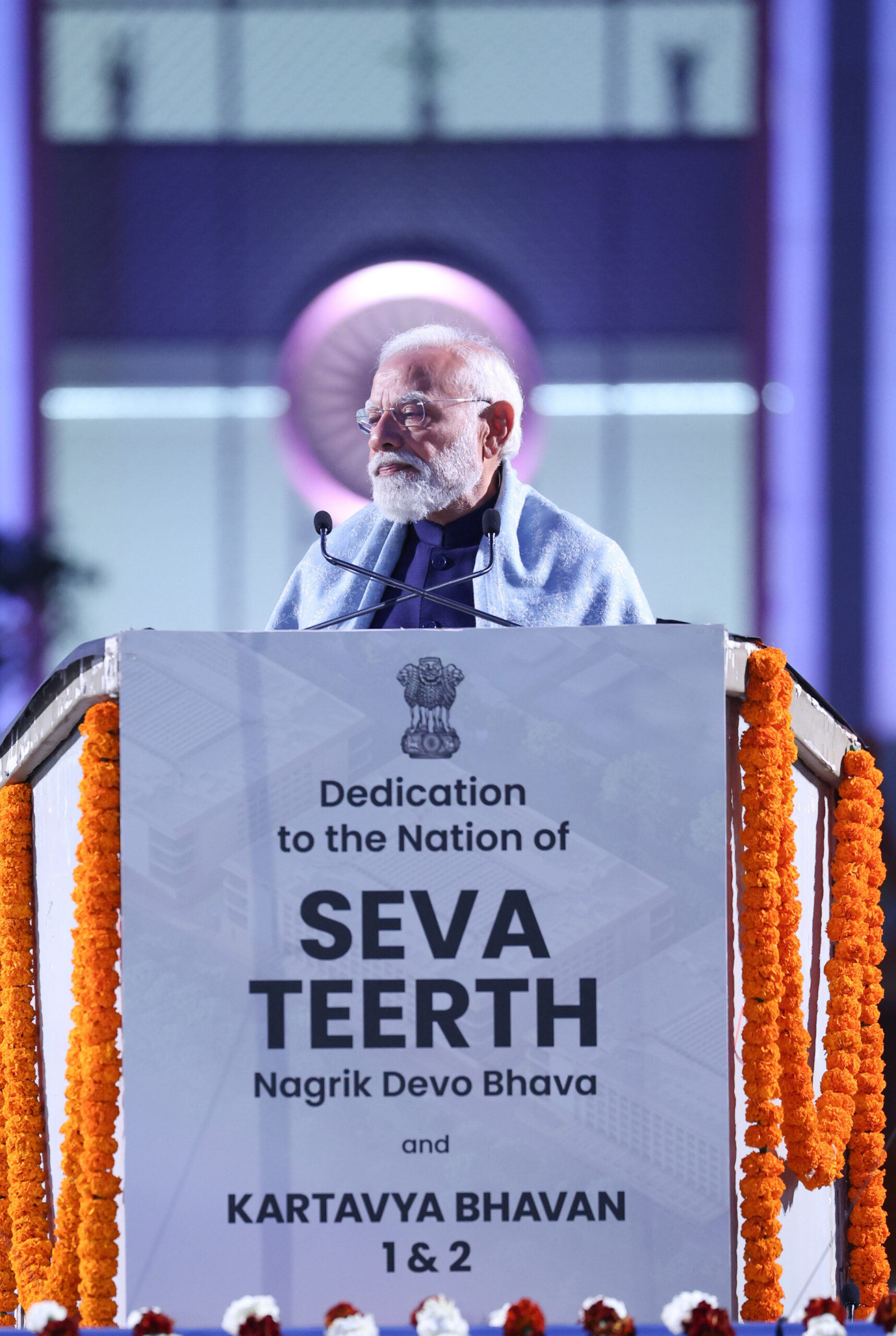
Respected Ministers of the Central Government, Members of Parliament, Government employees, distinguished guests, and my dear companions!
Today, we are witnessing the making of a new history. On this auspicious day of Vikram Samvat 2082, Phalguna Krishna Paksha, Vijaya Ekadashi-which also corresponds to Magha 24, Shaka Samvat 1947, and in today’s common calendar, February 13-India’s developmental journey is entering a new chapter. In our scriptures, Vijaya Ekadashi holds great significance; any resolve taken on this day is destined to succeed. Today, we too are entering Seva Tirtha and Kartavya Bhavan with the resolve of a developed India. The divine blessing of victory is with us in our mission. I extend my congratulations to all of you, to the entire PMO team, the Cabinet Secretariat, and employees of various departments on the inauguration of Seva Tirtha and the new buildings. I also express my gratitude to the engineers and workers who contributed to their construction.
Friends,
After independence, many crucial decisions and policies were made in the buildings of South Block and North Block. But it is also true that these structures were built as symbols of the British Empire. Their purpose was to keep India chained in slavery for centuries.
Friends,
You know well that once upon a time, Kolkata was the capital of India. But during the period of Bengal’s partition in 1905, Kolkata had become the stronghold of anti-British movements. Therefore, in 1911, the British shifted the capital from Kolkata to Delhi. Subsequently, the construction of the North Block and South Block began, designed to serve the needs and mindset of colonial rule. When these buildings on Raisina Hills were inaugurated, the then Viceroy declared that they reflected the wishes of the British monarch, meaning they were instruments to impose the king’s vision upon enslaved India. Raisina Hills was chosen deliberately so that these buildings would tower above all others, unmatched in stature. By contrast, Seva Tirtha is not perched on a hill but is grounded, closer to the soil. While South Block and North Block embodied colonial thinking, today I proudly declare that Seva Tirtha and Kartavya Bhavan embody the aspirations of the Indian people. Decisions taken here will not reflect the will of a monarch, but the expectations of 1.4 billion citizens. With this spirit, I dedicate Seva Tirtha and Kartavya Bhavan to the people of India.
Friends,
The first quarter of the 21st century has now concluded. Our vision of a developed India must be reflected not only in policies and schemes but also in our workplaces and institutions. The places from which the nation is governed must be both effective and inspiring, impressive yet motivating. New technologies are rapidly transforming our environment, but the old buildings are inadequate to accommodate these advancements. South Block and North Block faced space constraints, limited facilities, and were nearly a century old, deteriorating from within. Moreover, challenges persisted: even decades after independence, ministries operated from over 50 different locations across Delhi. Every year, more than ₹1,500 crore was spent just on rent for these buildings. Daily logistics for 8,000–10,000 employees moving between offices added further costs. With the construction of Seva Tirtha and Kartavya Bhavan, these expenses will be reduced, time will be saved, and productivity will increase.
Friends,
Amid this transformation, the memories of the old buildings will remain with us. Many important decisions were made there while facing different challenges. Those premises gave direction to the nation and witnessed numerous reforms. They are an immortal part of India’s history. Therefore, we have decided to dedicate those buildings as museums for the nation. They will become part of the Yuge Yugeen Bharat Museum, serving as centers of inspiration for future generations. When young people visit, the historical legacy will guide them.
Friends,
In this journey toward a developed India, we must free ourselves from the mentality of slavery. Unfortunately, even after independence, symbols of colonial rule continued to burden us. Consider the situation earlier: the Prime Minister’s residence was called Race Course Road. The Vice President had no designated residence. The road leading to Rashtrapati Bhavan was called Rajpath in a democracy. There was no memorial for soldiers who sacrificed their lives after independence, nor for police personnel who laid down their lives. Thus, the capital of free India remained deeply entangled in colonial mentality, with its buildings and public spaces marked by symbols of subjugation.
But friends,
As they say, time never remains the same. In 2014, the nation resolved that the colonial mindset would no longer prevail. We began a campaign to change it. We built the National War Memorial to honor our martyrs. We built the Police Memorial to honor the valor of our police. Race Course Road was renamed Lok Kalyan Marg. This was not merely a change of name, but a sacred effort to transform the spirit of governance into one of service.
Friends,
Behind these decisions lies a deep sentiment, a vision. It connects our present, past, and future with India’s pride. The place once known as Rajpath lacked adequate facilities and arrangements for citizens. We redeveloped it as Kartavya Path, which today is a vibrant public space for families, children, and visitors from across the country. In this same complex, we installed a grand statue of Netaji Subhas Chandra Bose. For long, our capital lacked such tributes to our heroes. We resolved that the new generation must draw inspiration from them at the very heart of the capital. Changes were also made in the Rashtrapati Bhavan complex: Mughal Gardens were renamed Amrit Udyan. When the new Parliament building was constructed, we did not forget the old one; we gave it a new identity as Samvidhan Sadan. When ministries are brought together in one complex, those buildings were named Kartavya Bhavan. These initiatives of renaming were not mere wordplay; they reflected a consistent ideological thread-an independent identity for independent India, free from colonial marks.
Friends,
The new Prime Minister’s Office is named Seva Tirtha. The spirit of service is the soul of India, the true identity of India. Shri Ramakrishna Paramhansa used to say: Shiva Jnana se Jiva Jnana Seva-service to humanity is service to God. This is not merely a spiritual thought, but a philosophy of nation-building. This building will remind us every moment that governance means service, responsibility means dedication. Our scriptures say: Seva Paramo Dharmah-service is the highest duty. This is the vision of the Prime Minister’s Office and the government. Therefore, Seva Tirtha is not just a name, but a resolve. Seva Tirtha means a place sanctified by service to citizens, a place where the resolve of service is fulfilled. Tirtha itself means “that which helps one to cross over, to achieve goals.” Today, India faces the goal of becoming a developed nation, of becoming self-reliant. We must free millions from poverty, free the nation from the mentality of slavery-and this will be achieved only through the power of service.
Friends,
Today, as India rides the Reform Express, as India writes a new chapter in international relations, as new trade agreements open doors of opportunity, and as the nation moves swiftly toward the goal of saturation, the new momentum of your work and your renewed confidence within Seva Tirtha and Kartavya Bhavan will play a vital role in achieving the country’s objectives.
Friends,
Our culture teaches us that before every auspicious undertaking, we invoke blessings, seek well-being, and take a vow of goodness. The Vedic mantra guides us: “Ā no bhadrāḥ kratavo yantu viśvataḥ”-may noble thoughts come to us from every direction. This should be the very soul of this building. In India’s great democracy, the people’s ideas are our strength, their dreams are our capital, their expectations are our priority, and their aspirations are our guiding light. There must be no wall, no distance between these sentiments and this institution. Policies will come alive only when you understand the people’s dreams; decisions will be effective only when you feel the people’s aspirations. Over the past 11 years, we have witnessed a new model of governance-one where the citizen is at the center of every decision. “Nagarik Devo Bhava”-the citizen is divine-is not just a phrase, it is our work culture. You must embody this spirit as you enter these new buildings. Every decision taken in Seva Tirtha, every file processed here, every moment spent here must be dedicated to improving the lives of 1.4 billion Indians. I urge every officer, every employee, every karmayogi: whenever you step into this building, pause for a moment, reflect, and ask yourself-will my work today make life easier for millions of citizens? This self-reflection will become the greatest strength of this place.
Friends,
We are not here to display authority; we are here to fulfil responsibility. And we have seen that when governance is driven by service, the results are extraordinary. That is how 250 million people rise out of poverty, that is how the economy gains new momentum.
Friends,
Today, a developed India by 2047 is not merely our goal-it is India’s pledge before the world. Therefore, every policy framed here, every decision taken here must be inspired by the spirit of continuous service. And one day, when you retire or move on from this building, you will look back with pride at these days. You will be able to say: yes, during my time in Seva Tirtha and Kartavya Bhavan, every day I served the citizens, every decision I took was in the interest of the nation. That moment will bring you peace, that moment will be your greatest achievement, that moment will be your personal treasure, and that treasure will fill your life with honor.
Friends,
Mahatma Gandhi believed that the grand edifice of rights is built upon the foundation of duty. When we fulfill our duties, we can confront even the greatest challenges and find solutions. Our Constitution-makers emphasized duties for this very reason. We must remember: the realization of millions of citizens’ dreams rests upon duty. Duty is the beginning, duty is the lifeblood of this vibrant nation. Duty is the bond of compassion and diligence. Duty is the hope of resolutions, the pinnacle of hard work, the solution to every problem, and the faith of a developed India. Duty is equality, duty is affection, duty is universal, duty is all-embracing. Duty is the mantra woven into Sabka Saath, Sabka Vikas. Duty is the spirit of dedication to the nation. Duty is the willpower that lights every life. Duty is the joy of self-reliant India. Duty is the guarantee of a bright future for the coming generations. Duty is the flagbearer of Mother India’s life-force. Duty is every act performed with devotion to the nation. Duty is the awakened path of practising Nagarik Devo Bhava.
Friends,
With this spirit of duty, keeping it supreme, we must enter Seva Tirtha and the newly built complexes with a sense of responsibility.
Friends,
Today, India is advancing rapidly toward new heights, toward a new era. In the years ahead, our identity will not be defined merely by the economy, but by the quality of our governance, the clarity of our policies, and the dedication of our karmayogis. Every decision taken in Seva Tirtha and Kartavya Bhavan will not just be a file’s resolution-it will shape the direction of a developed India in 2047. Remember, 2047 is not just a date; it is the deadline for 1.4 billion dreams. In this journey, every institution matters, every officer matters, every employee, every karmayogi matters. I want Seva Tirtha to become a symbol of sensitive governance, a role model of citizen-centric administration, a place where service, not power, is visible; where commitment, not position, is evident; where responsibility, not authority, is paramount. I am confident that our resolve will write history, and our hard work will guide generations. As I said from the Red Fort: “This is the time, the right time.” Let us make the best use of every moment. Let us act with the spirit of Nation First, so that future centuries may say, this was the time when India redefined its destiny; this was the time when India took bold steps with new energy and new momentum toward a thousand years of bright future. With this conviction, I extend my heartfelt best wishes to all of you. Thank you very much.
Vande Mataram!
Seva Teerth, Kartavya Bhavan 1 and 2 mark an important milestone in India’s journey towards Viksit Bharat. These reflect our commitment to citizen-centric governance and national progress. https://t.co/vCeE8Uyz69
— Narendra Modi (@narendramodi) February 13, 2026
Seva Teerth and Kartavya Bhavan have been built to fulfil the aspirations of the people of India. pic.twitter.com/JX4b6r9kAK
— PMO India (@PMOIndia) February 13, 2026
As we move towards a Viksit Bharat, it is vital that India sheds every trace of colonial mindset. pic.twitter.com/I1aZ1qOwWu
— PMO India (@PMOIndia) February 13, 2026
Race Course Road was renamed Lok Kalyan Marg. This was not merely a change of name.
— PMO India (@PMOIndia) February 13, 2026
It was an effort to transform the mindset of power into a spirit of service. pic.twitter.com/px9QxnlWRy
The new Prime Minister's Office has been named Seva Teerth.
— PMO India (@PMOIndia) February 13, 2026
Seva, or the spirit of service, is the soul of India. It is the identity of India. pic.twitter.com/RPIQhU1Qr2
दिल्ली में आज 'सेवा तीर्थ' और कर्तव्य भवन के लोकार्पण के अवसर पर सेवा तीर्थ स्मारक डाक टिकट और सिक्का जारी कर गौरवान्वित हूं। pic.twitter.com/r130HzBnYe
— Narendra Modi (@narendramodi) February 13, 2026
आज मैंने जिस अमृत भावना के साथ 'सेवा तीर्थ' और कर्तव्य भवन को राष्ट्र को समर्पित किया है, वो 140 करोड़ देशवासियों की आकांक्षाओं और अपेक्षाओं को पूरा करने का सशक्त आधार बनेंगे। pic.twitter.com/HMdsvwlb4B
— Narendra Modi (@narendramodi) February 13, 2026
बीते 11 वर्षों से हम गुलामी की मानसिकता को बदलने के अभियान में जुटे हैं। हमारा मंत्र है- स्वतंत्र भारत की स्वतंत्र पहचान, गुलामी से मुक्त निशान! pic.twitter.com/ITbaLp9mCG
— Narendra Modi (@narendramodi) February 13, 2026
'सेवा तीर्थ' के नाम में ही एक बड़ा संदेश है- देशवासियों की सेवा के संकल्प को सिद्धि तक ले जाने का एक पावन स्थल! pic.twitter.com/01HE9ntZWA
— Narendra Modi (@narendramodi) February 13, 2026
कर्तव्य इस जीवंत राष्ट्र की प्राण वायु है। यह कोटि-कोटि देशवासियों के सपनों को साकार करने के हमारे संकल्प को नई ऊर्जा दे रहा है। pic.twitter.com/W7ffr9w3qT
— Narendra Modi (@narendramodi) February 13, 2026


