Civilisational Dialogue Forum in Delhi&description=His&redirect_uri=https://www.pmindia.gov.in/en/news_updates/pms-address-at-the-inauguration-of-first-shanghai-cooperation-organisation-sco-civilisational-dialogue-forum-in-delhi/&picture=https://www.pmindia.gov.in/wp-content/uploads/2026/11/H20261120220743.jpeg "facebook")


His Excellency the Secretary General of the SCO, India’s Minister of Culture, other Ministers of the Government of India, all Ministers, Ambassadors, High Commissioners, Dignitaries, Distinguished Scholars, eminent artists, esteemed guests from SCO countries, ladies and gentlemen.
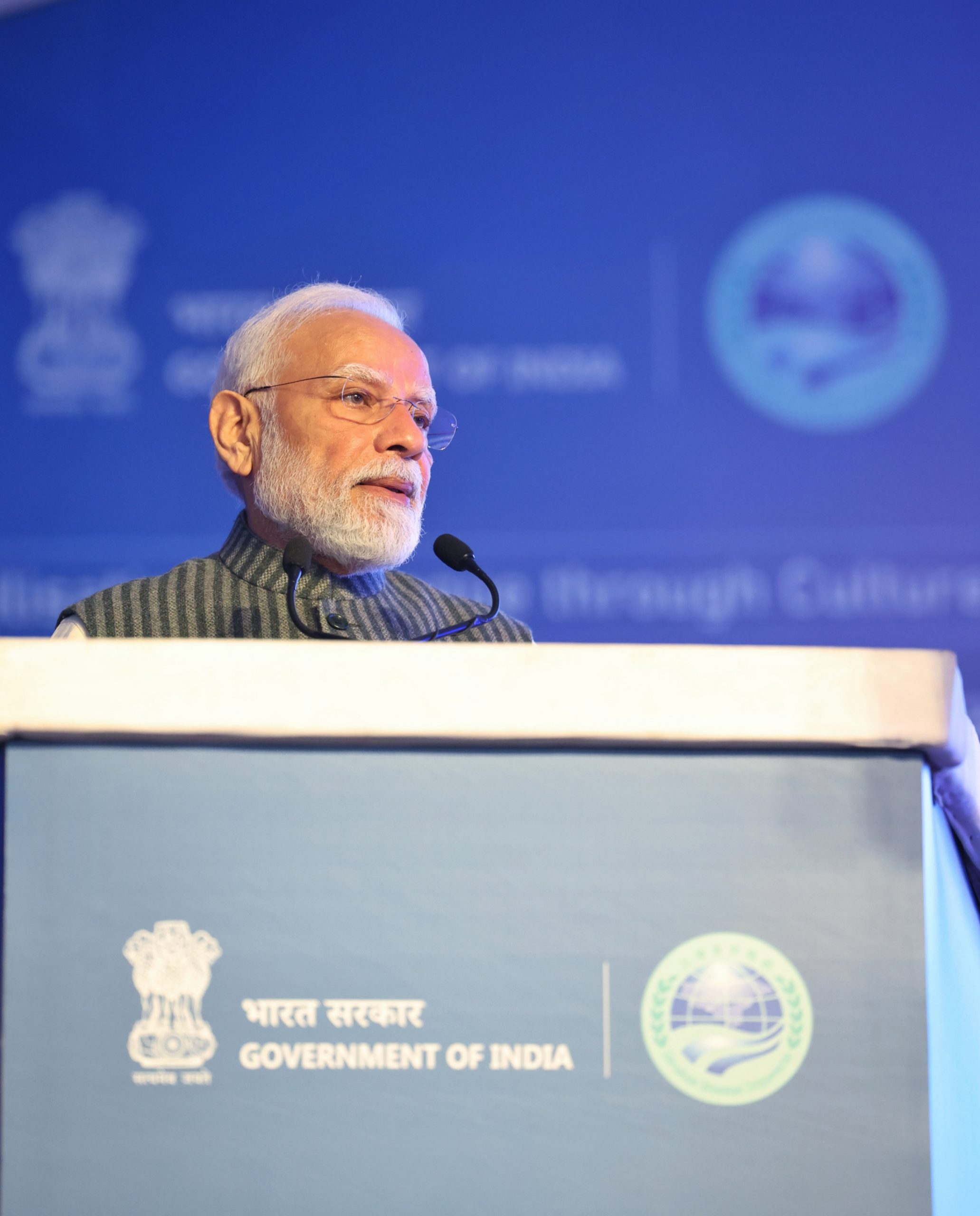
This is the first SCO Civilizational Dialogue Forum. I welcome all the guests who have come to India and extend my greetings to all of you. At a time when discussions around the world are dominated by war and unrest, we are holding a dialogue in India on civilizational connections. This is especially important because cultural connection is the strongest guarantee of global peace. Therefore, the significance of today’s event has become even greater.
Friends,
Only a few months ago, the Shanghai Cooperation Organisation completed 25 years of its establishment. Over the years, the SCO has significantly expanded cooperation in security, economy, and connectivity. In such a situation, cultural and civilizational cooperation will further strengthen relations among different countries. I am confident that this forum will generate new ideas, create new opportunities for cultural cooperation, and that our shared civilizational experiences will play an important role in bringing the world together.
Friends,
At this moment, we are at Delhi’s Purana Qila. This Purana Qila is an extraordinary cultural heritage of India. Its history is as fascinating as the stories associated with it. You may have already read and heard about it here. According to scholars, the history of this fort goes back thousands of years to the era of the Mahabharata. At such an ancient site, magnificent cultural performances, the energetic recitation of Vedic mantras, presentations of Buddhist philosophy, and the journey of Hanuman Ji not only reflected India’s culture but also conveyed a message of love and unity for humanity.
These emotions, these ideas, and these teachings are as ancient as they are universal. Beyond geopolitical boundaries, they naturally connect us with one another. This is also the purpose of this summit, and it is also the need of the present time. I hope all of you will enjoy this event and, by making it historic, will lay the foundation of a new tradition. A tradition for which the future will remember all of you.
Today, there is a great deal of discussion around international collaboration and people-to-people connect. This is an approach that our ancestors enriched over many centuries. Around five thousand years ago, there were trade relations between the Indus Valley Civilization and Mesopotamia. Later, other trade routes further expanded this contact. India, China, Central Asia, and many regions of Eurasia were connected through these ancient trade networks. Along these routes travelled not only merchants, but also scholars, travellers, and Buddhist monks. These journeys facilitated the exchange of ideas, languages, and traditions. Through Gandhara and Central Asia, the ideas contained in Buddhist texts reached China. Places such as Kucha and Dunhuang became important centres of this journey. Scholars such as Faxian, Xuanzang, and Yijing came to India from China. They studied India’s traditions of knowledge and carried them back to their homeland. Universities such as Nalanda became centres of this exchange of knowledge. Scholars such as Kumarajiva, who was born in Kucha in Central Asia, translated Buddhist texts into Chinese. In this way, humanity and civilization continued to enrich and develop themselves. I believe that empires may have changed the map of the world, but civilizational dialogues changed the ideas of the world and strengthened intellectual prosperity. Therefore, the SCO Civilizational Summit is not merely a ceremonial platform; it can become a platform for giving direction to the world.
Friends,
When knowledge travels from one place to another, the way it is expressed may change, but its impact and its role do not change. Whatever form knowledge takes, it spreads light. A major example of this is India’s Panchatantra. Its stories travelled into Persian and later into Arabic. In the form of Kalila wa Dimna, these stories assumed a new shape and became immortal across generations. Similarly, when the Ramayana travelled from India to Southeast Asia, it strengthened the same ideals there. In Cambodia, the Ramayana took the form of Reamker and found a place in local culture, performing arts, and literature.
Friends,
This cross-cultural exchange has been equally important in the fields of science and mathematics. The ideas of the great Indian mathematician Brahmagupta reached Baghdad. There, scholars such as Al-Khwarizmi made significant contributions in advancing mathematical knowledge.
Friends,
We find many examples of this shared journey in architecture and music as well. There is a deep cultural connection between the Maqam traditions of Central Asia and the Raga traditions of India. Sufi ideas and musical traditions enriched the development of Qawwali in India. The garden traditions of Samarkand and Herat in Central Asia influenced the Charbagh style in India. For these exchanges to continue flowing freely even today, the role of this summit and such initiatives becomes extremely important.
Friends,
Today, we have far greater opportunities than ever before. The technology of the 21st century has created new possibilities for cultural connectivity across the world. The routes on which our ancestors once had to travel for months now connect people from those same countries with one another in just a few seconds. Digital platforms have made knowledge sharing, cultural exchange, and international collaboration easier than ever before. The countries of the SCO should take full advantage of these new opportunities.
Friends,
Today, I would also like to offer a few suggestions in this direction before all of you distinguished guests. In the museums, libraries, and archives of our countries, invaluable heritage accumulated over thousands of years has been preserved. Ancient manuscripts, rare texts, historical documents, and artefacts reveal many dimensions of our shared connections. Today, technology provides excellent opportunities to bring this heritage to younger generations. We can cooperate in the digitisation and translation of ancient texts. Through joint research projects, we can bring new dimensions of our shared history before the world. This will enable a young person sitting in any part of the world to better understand the cultural heritage of another country.
Friends,
Many of our great literary works are still available only in limited languages. With the help of AI, the translation of these works can be accelerated significantly. Today we have more tools than ever before, and we should make full use of them.
Friends,
There are many more opportunities for cultural exchange that deserve our attention. For example, museums and cultural institutions in our countries can organise joint exhibitions. Universities and research institutions can promote exchange programmes for scholars and researchers. Cultural tourism can also become an important area of cooperation among us. Many historical sites linked to the Silk Routes and Buddhist heritage exist across our countries. We can explore possibilities for connecting them through heritage circuits and cultural routes. Similarly, joint cultural festivals and artists’ exchange programmes can bring our art and cultural traditions to new audiences. I believe such efforts will give our citizens better opportunities to understand each other’s cultures more closely.
Friends,
The responsibility for taking forward this civilizational dialogue that we are advancing today to even greater heights in the coming decades rests with our youth. Today’s younger generation is connected through technology and wants to understand the world better. We must provide more opportunities for our youth to connect with each other’s languages, literature, and cultural traditions. Our young artists, writers, and filmmakers can take our shared heritage to future generations through digital media and other creative platforms. We must also connect local artists and artisans to these efforts.
Friends,
In India, even when we perform a prayer or a ritual, we conclude by praying: May there be goodwill among all living beings. May the world be blessed. This is because our culture has taught us the ideal of Vasudhaiva Kutumbakam – the whole world is one family. Therefore, the desire for our own well-being is inseparably linked with the well-being of the world. We regard mutual harmony as the foundation of global well-being.
Friends,
The most important requirement for mutual harmony is mutual trust. And mutual trust develops when we feel that we share something with one another. Therefore, today there is a need to focus on what is shared among us. From India’s experience, I can say that when we adopt such a broad outlook, our diversity itself becomes the foundation of our unity. That is why, despite our many languages, lifestyles, and traditions, we remain deeply connected in India. In India, we accept diversity. We celebrate diversity. We derive this inspiration hi from our Vedas, whose recitation we listened to at the beginning of this programme.
Friends,
Our Vedas say: Sangachchhadhwam Samvadadhwam Sam Vo Manamsi Janatam – let us walk together, let us engage in dialogue, and let there be harmony in our thoughts. With this spirit, I once again congratulate all of you on the first SCO Civilizational Dialogue Forum. Being the first, it carries special significance. I extend my best wishes to all of you for successful and meaningful discussions.
Thank you very much.
Namaskar.
Speaking at the SCO Civilisational Dialogue Forum in Delhi. https://t.co/RzZCS5bjnd
— Narendra Modi (@narendramodi) November 20, 2026
साम्राज्यों ने दुनिया के नक्शे जरूर बदले हैं, लेकिन civilisational dialogues ने दुनिया के विचार बदले हैं, उन्हें समृद्ध किया है। इसीलिए, SCO civilisational summit केवल एक ceremonial platform नहीं है। ये विश्व को दिशा देने का एक मंच बन सकता है: PM @narendramodi
— PMO India (@PMOIndia) November 20, 2026
21वीं सदी की Technology ने दुनिया में Cultural Connectivity की नई संभावनाएं पैदा की हैं। जिन रास्तों पर कभी हमारे पूर्वजों को महीनों यात्रा करनी पड़ती थी, आज उन्हीं देशों के लोग कुछ ही सेकंड में एक-दूसरे से जुड़ सकते हैं। Digital Platforms ने Knowledge Sharing, Cultural Exchange और International Collaboration को पहले से आसान बना दिया है। SCO के देशों को इन नई संभावनाओं का पूरा लाभ उठाना चाहिए: PM @narendramodi
— PMO India (@PMOIndia) November 20, 2026
हमारे देशों के Museums, Libraries और Archives में हजारों वर्षों की अनमोल विरासत सुरक्षित है। प्राचीन Manuscripts, दुर्लभ ग्रंथ, ऐतिहासिक दस्तावेज और कलाकृतियां हमारे जुड़ाव के अनेक पहलुओं को सामने लाती हैं। आज Technology की मदद से इस विरासत को नई पीढ़ी तक पहुंचाने के बहुत अच्छे अवसर बने हैं। हम प्राचीन ग्रंथों के Digitisation और Translation में सहयोग कर सकते हैं। Joint Research Projects के माध्यम से हम अपने साझा इतिहास के नए पहलुओं को सामने ला सकते हैं। इससे दुनिया के किसी भी हिस्से में बैठा एक युवा, दूसरे देश की Cultural Heritage को कहीं बेहतर तरीके से समझ सकेगा: PM @narendramodi at the SCO Civilisational Dialogue Forum
— PMO India (@PMOIndia) November 20, 2026
हमारी संस्कृति ने हमें ‘वसुधैव कुटुंबकम्’ की सीख दी है। यानी, ये पूरा विश्व ही हमारा परिवार है। इसलिए, हमारे यहाँ अपने कल्याण की इच्छा विश्व कल्याण के भाव में ही रची बसी है। हम आपसी सद्भाव को ही global wellbeing का base मानते हैं: PM @narendramodi
— PMO India (@PMOIndia) November 20, 2026